GUIDE · POSTAL HISTORY OF ULM
From the loss of imperial freedom to a fortress, industrial and transport city: how Ulm reinvented itself in a hundred years – told through letters, covers and picture postcards.
By Paris Dimitriadis
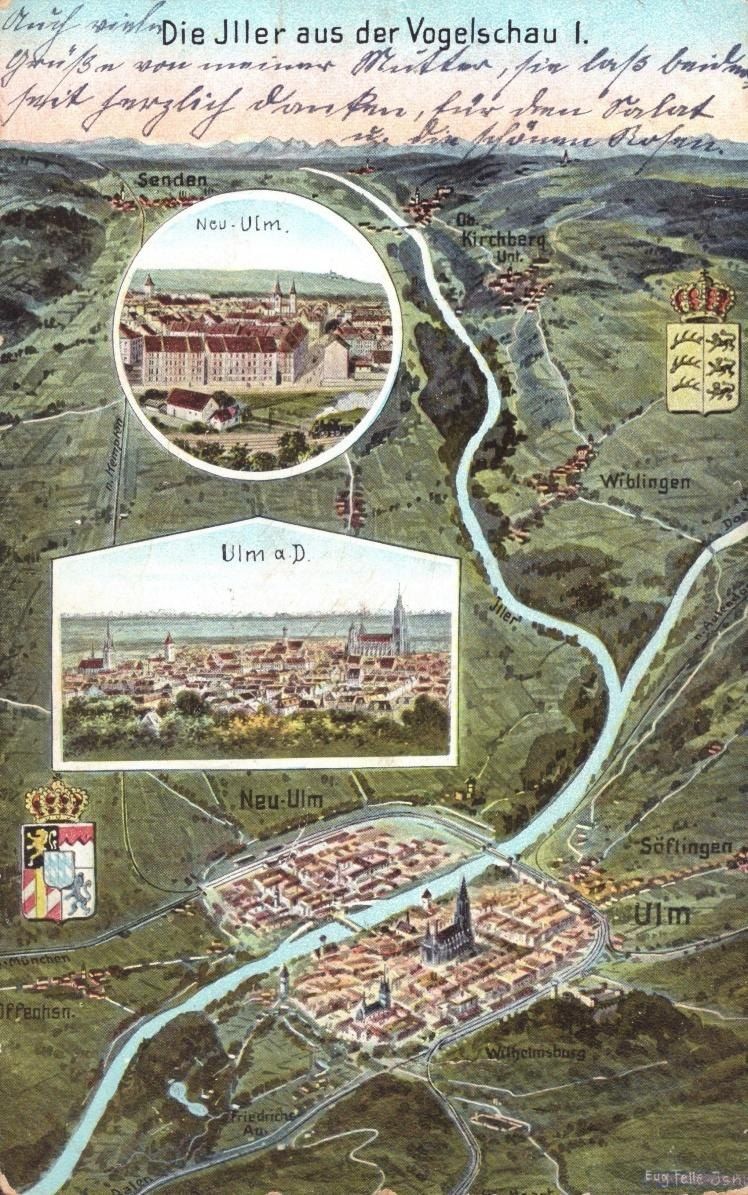
Bird’s-eye view of Ulm, mid-19th century, as an artist card by Eugen Felle: the city with the new Federal Fortress, the Danube and the Iller, Württemberg and Bavaria.
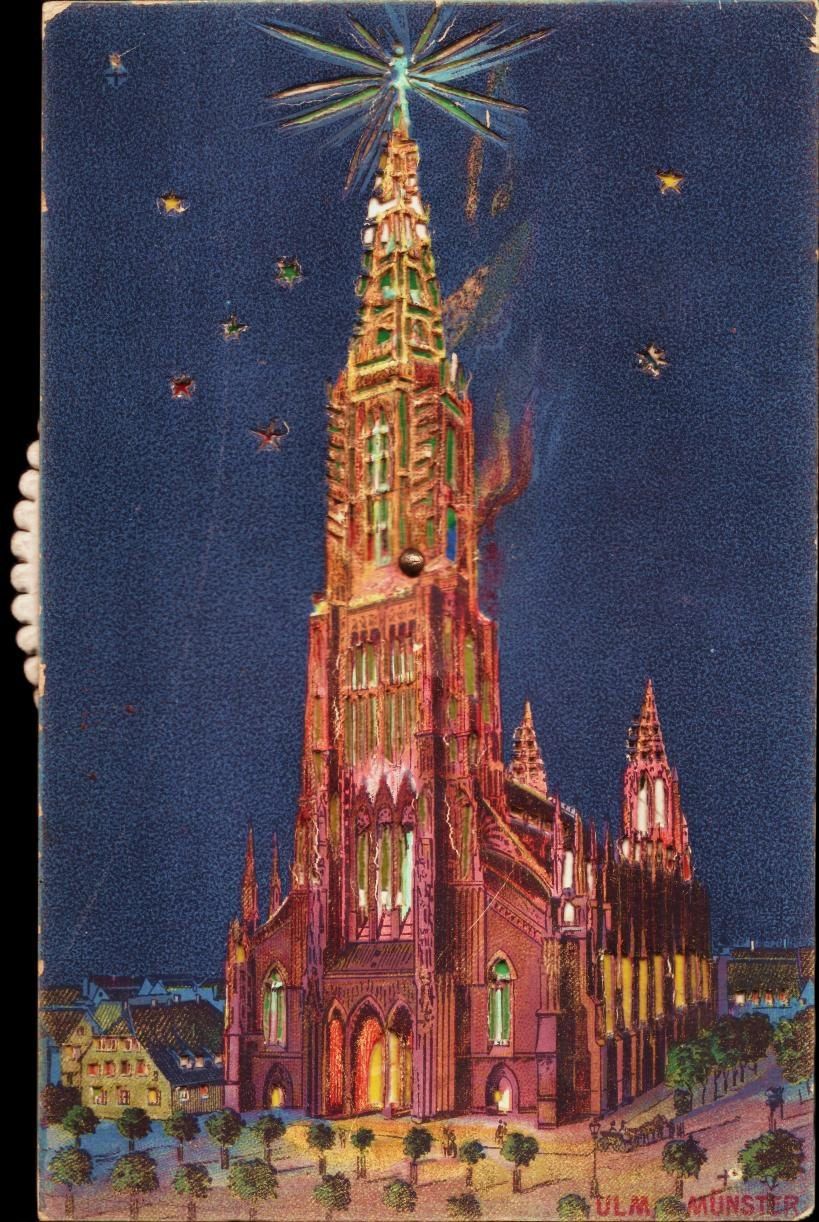
Mechanical colour card: the Minster illuminated at night – one of the finest Minster cards.
In 1810 Ulm became part of Württemberg. The city had lost its imperial freedom, its trade and its importance. A hundred years later, on the eve of the First World War, it was a modern, self-confident city with a fortress, industry, a railway junction and the tallest church spire in the world. Letters, covers and picture postcards show the way it went.
In the decades after 1810 Ulm found its place in the Kingdom of Württemberg. Council minutes, official letters and court letters show how the administration was reorganised while preserving old Ulm customs. A receipt of the Royal Württemberg mail coach office at Ulm from 1834 records a parcel said to contain 2,600 gulden – the fee paid was 3 gulden 50 kreuzer, a lot of money for an insured item. Oversized court letters went as far as Vienna.
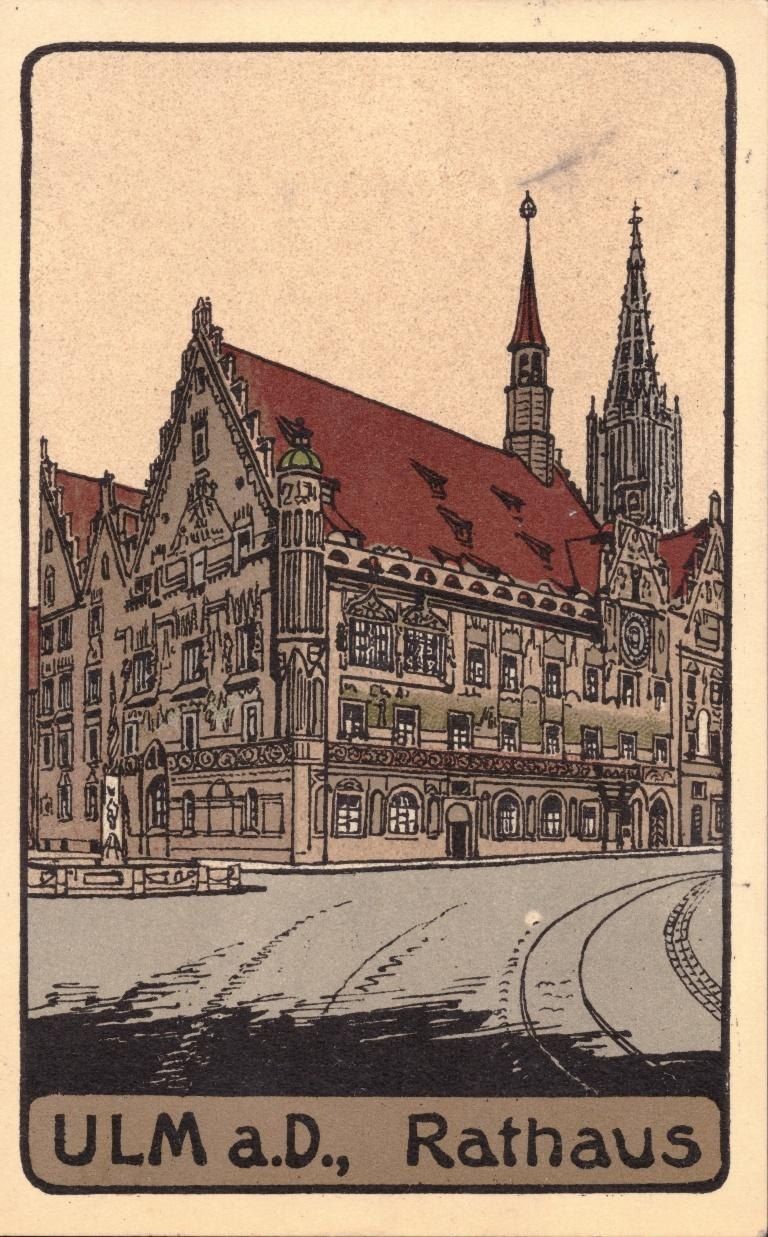
Ulm Town Hall on a lithographed card of 1913.
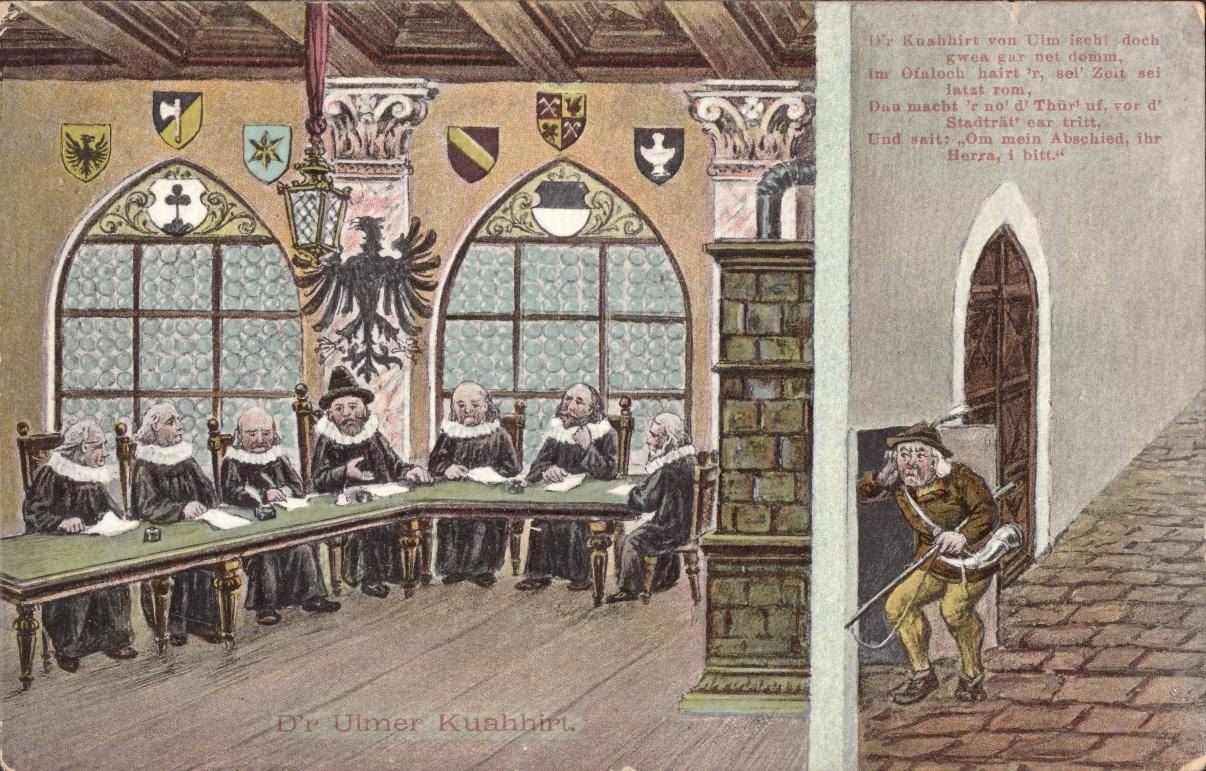
Humorous card: the Ulm cowherd hears of his dismissal, storms into the council meeting and resigns himself.
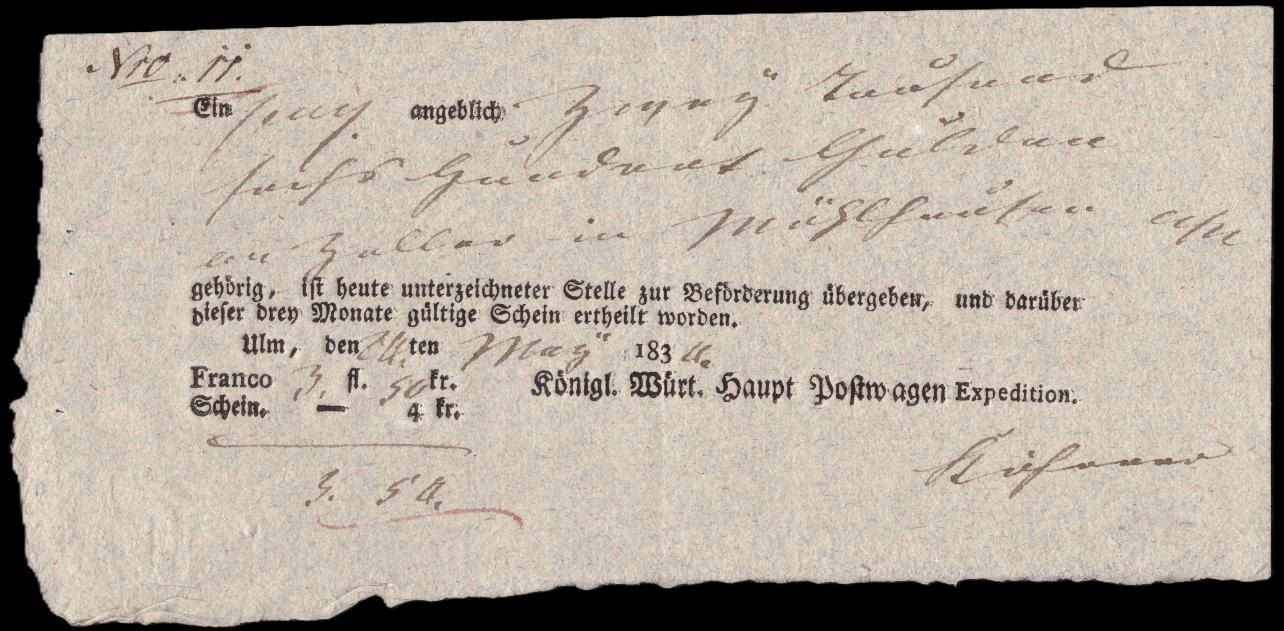
Receipt of the Ulm mail coach office, 1834, for a parcel said to contain 2,600 gulden; fee 3 gulden 50 kreuzer.
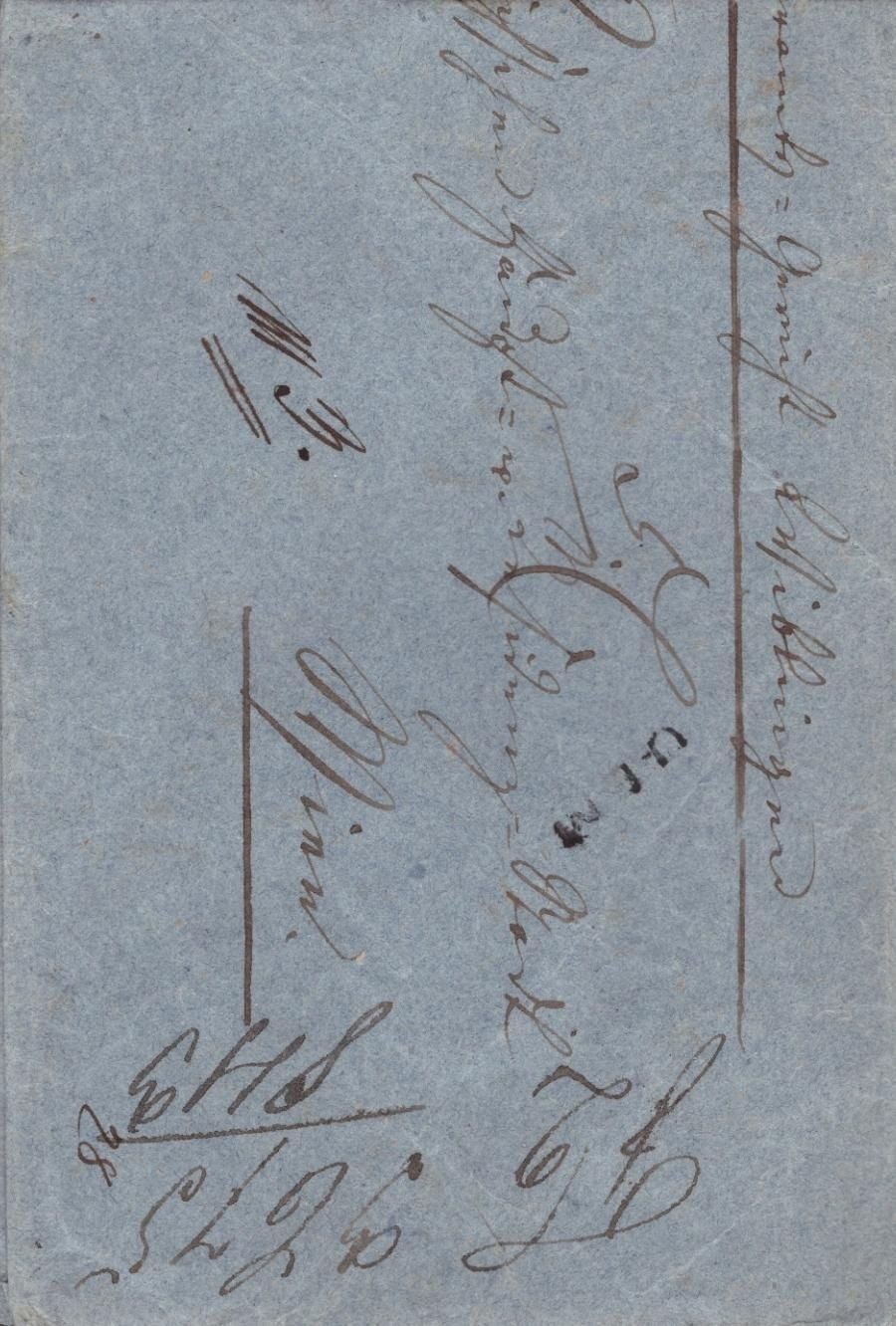
Early oversized court letter (11 × 32 cm) from the royal court of Ulm-Wiblingen to the civil court in Vienna, carried “zu Wagen” (by coach).
In 1842 the art dealer Heinrich Nübling reminded Countess von Spaur of an old debt – legally ineffective, since the reminder should have been sent to the Count. Count Spaur became known for bringing Pope Pius IX to safety from revolutionary Rome in 1848.
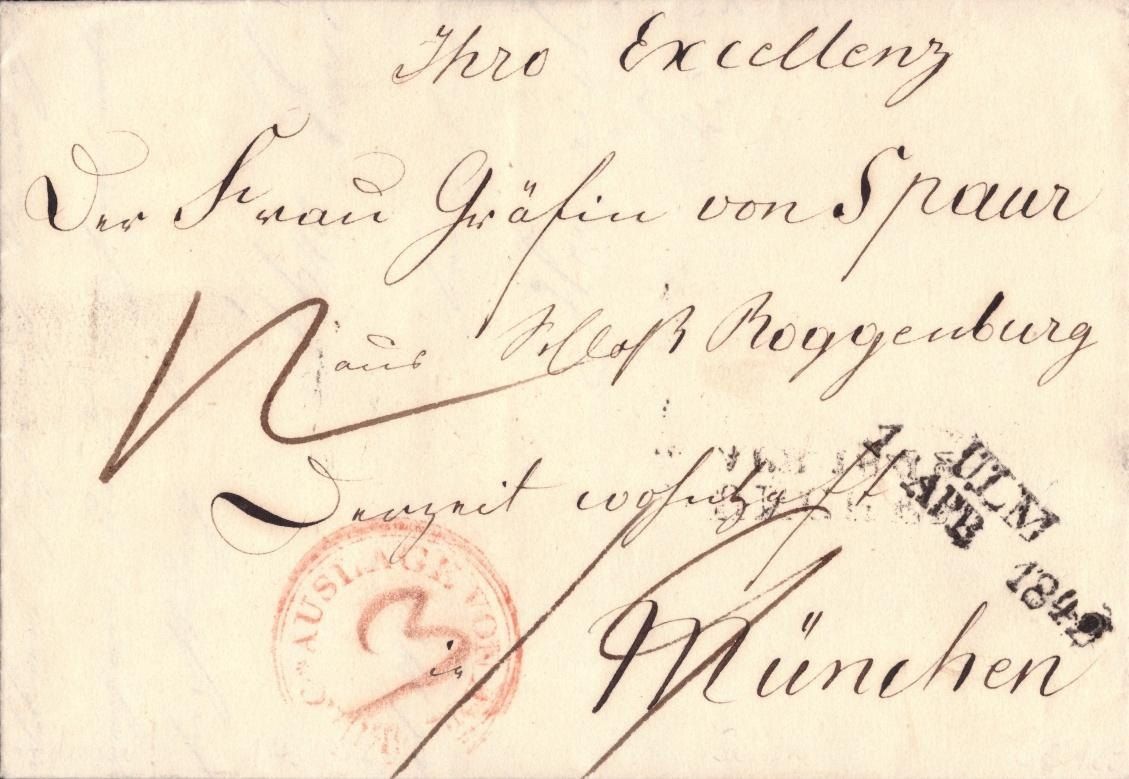
Letter from the art dealer Heinrich Nübling to Countess von Spaur in Munich, 1842.
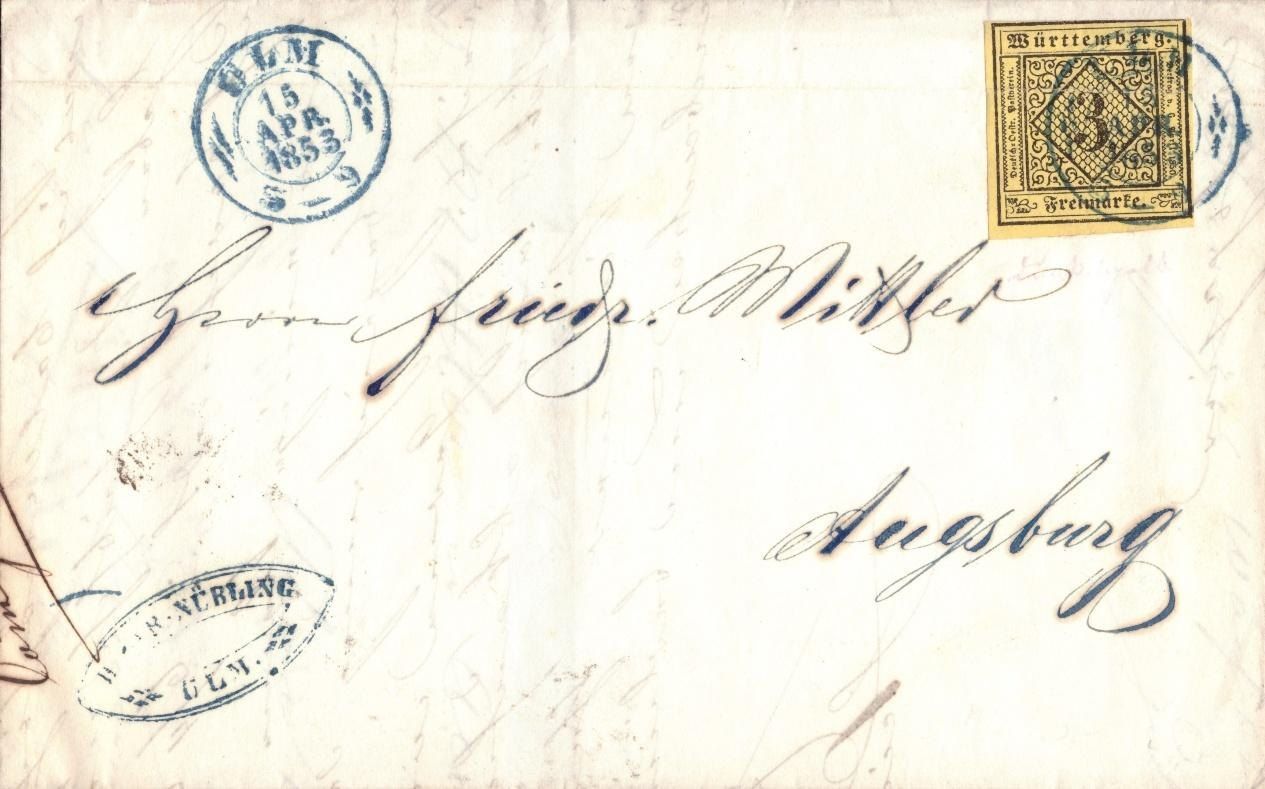
Business letter from Nübling, Ulm to Augsburg, 1853, franked with a scarce shade.
The recovery was carried by banking, trade and inventiveness. A letter of 1858 to Pest (today Budapest), addressed to the private banker von Malvieux, bears a vertical strip of three of the 3 kreuzer stamp – vertical strips are much scarcer than horizontal ones. A business letter of 1873 went to Johann Contarini in Venice, from one of the old patrician families of the lagoon city.
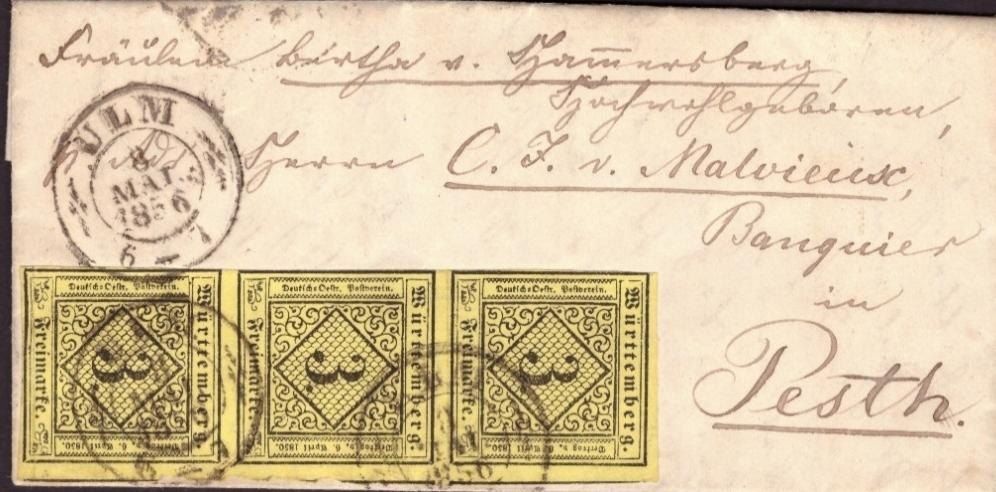
Vertical strip of three 3 kreuzer on a letter from Ulm to Pest, 8 May 1858.
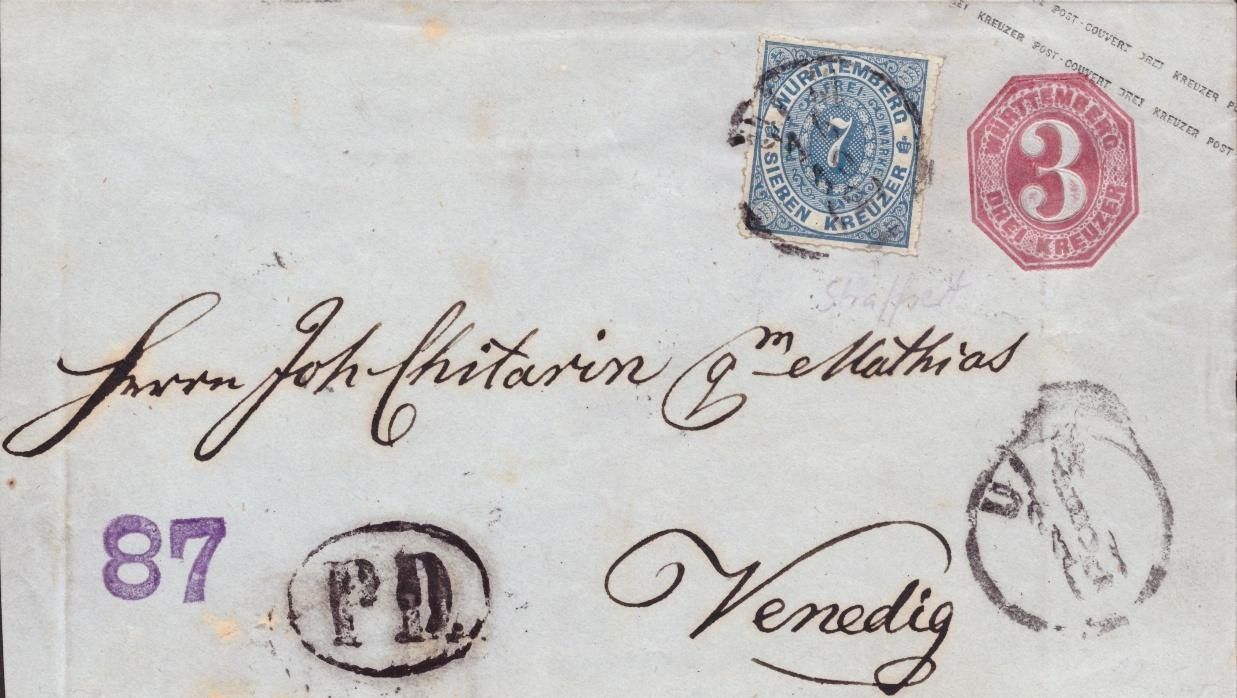
Business letter from Ulm to Venice to Johann Contarini, 1873.
Conrad Dietrich Magirus (1824–1895) founded Ulm’s first fire brigade in 1846 and in 1866 his factory for ladders, pumps and fire engines; the turntable ladder made the name famous worldwide. Philipp Jakob Wieland (1793–1873) turned a bell foundry into works for brass, copper and other non-ferrous metals – and introduced one of Germany’s earliest company health insurance schemes. By 1913 the Eberhardt Brothers plough factory had sold around 1.5 million ploughs.
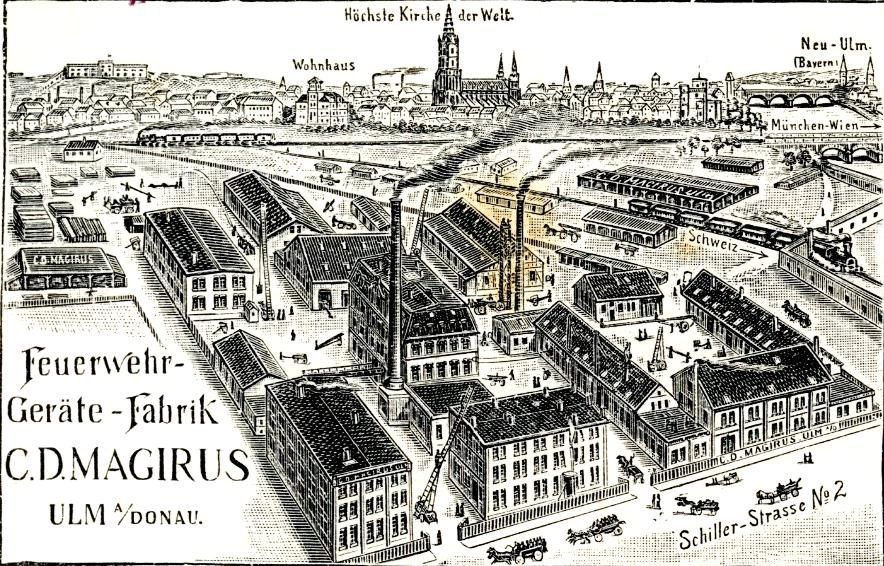
The C. D. Magirus fire equipment factory in Ulm.
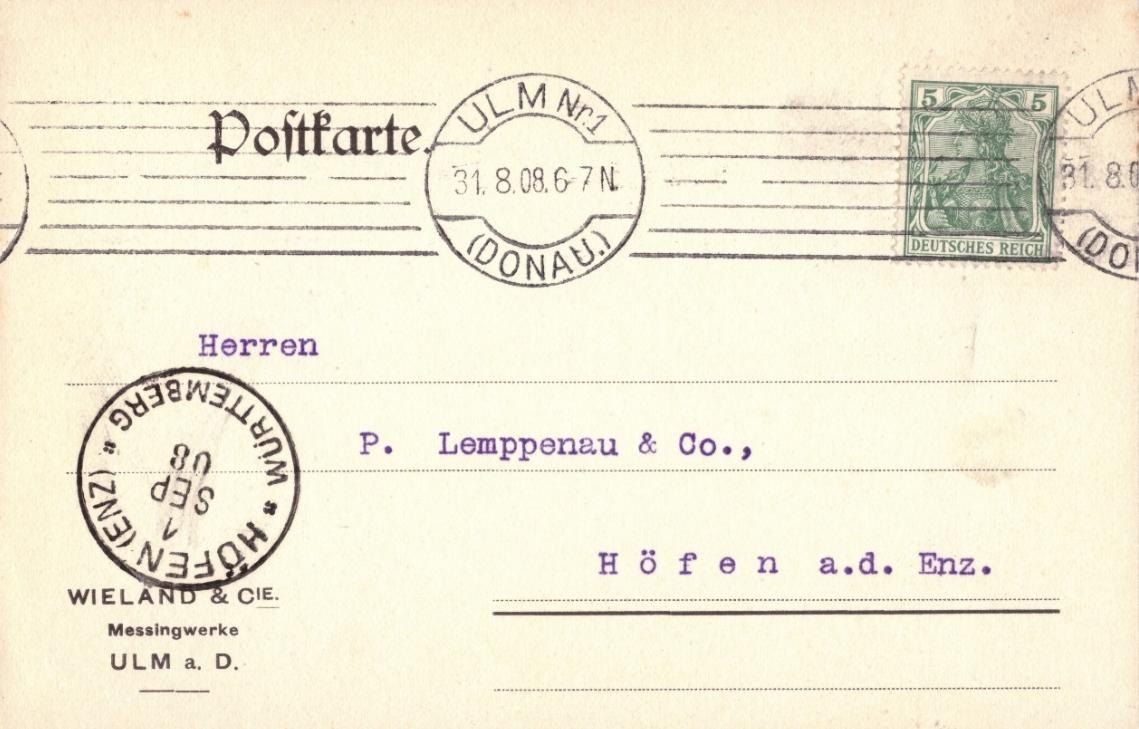
Postcard of Wieland & Cie., 1913: order confirmation for two copper sheets.
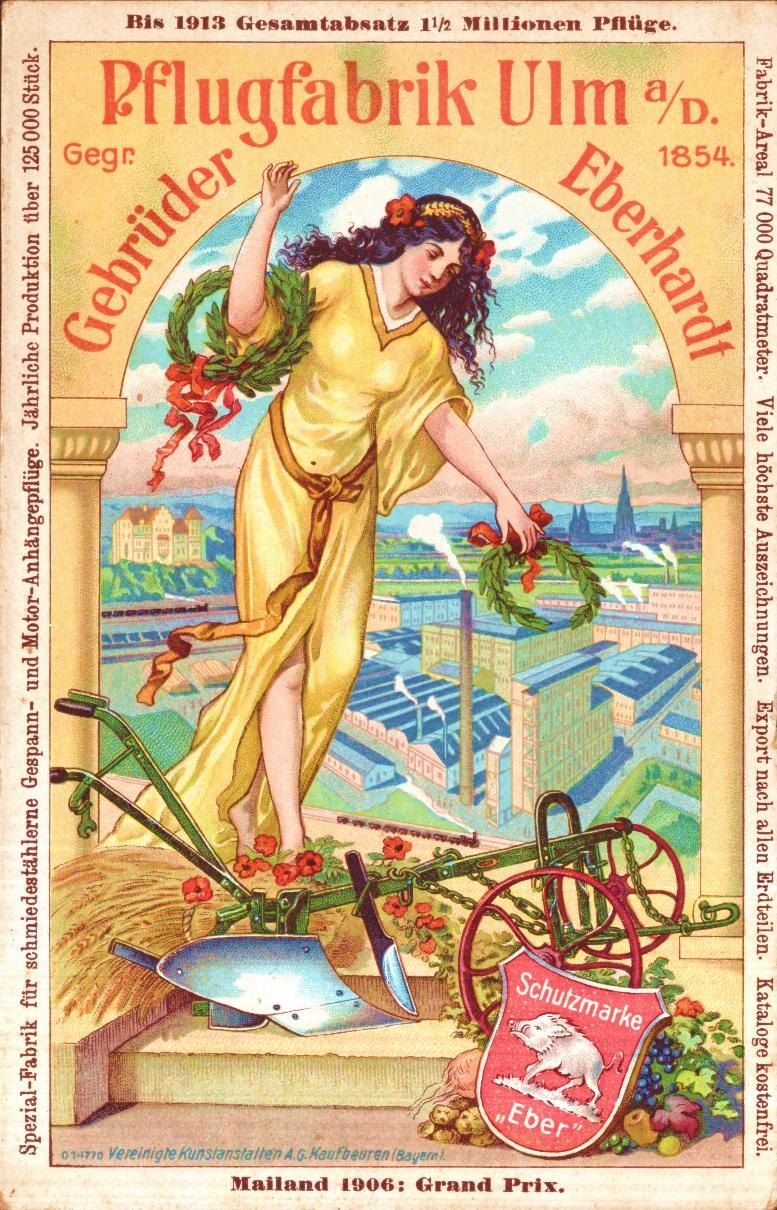
Advertising card of the Eberhardt Brothers plough factory, Grand Prix Milan 1906.
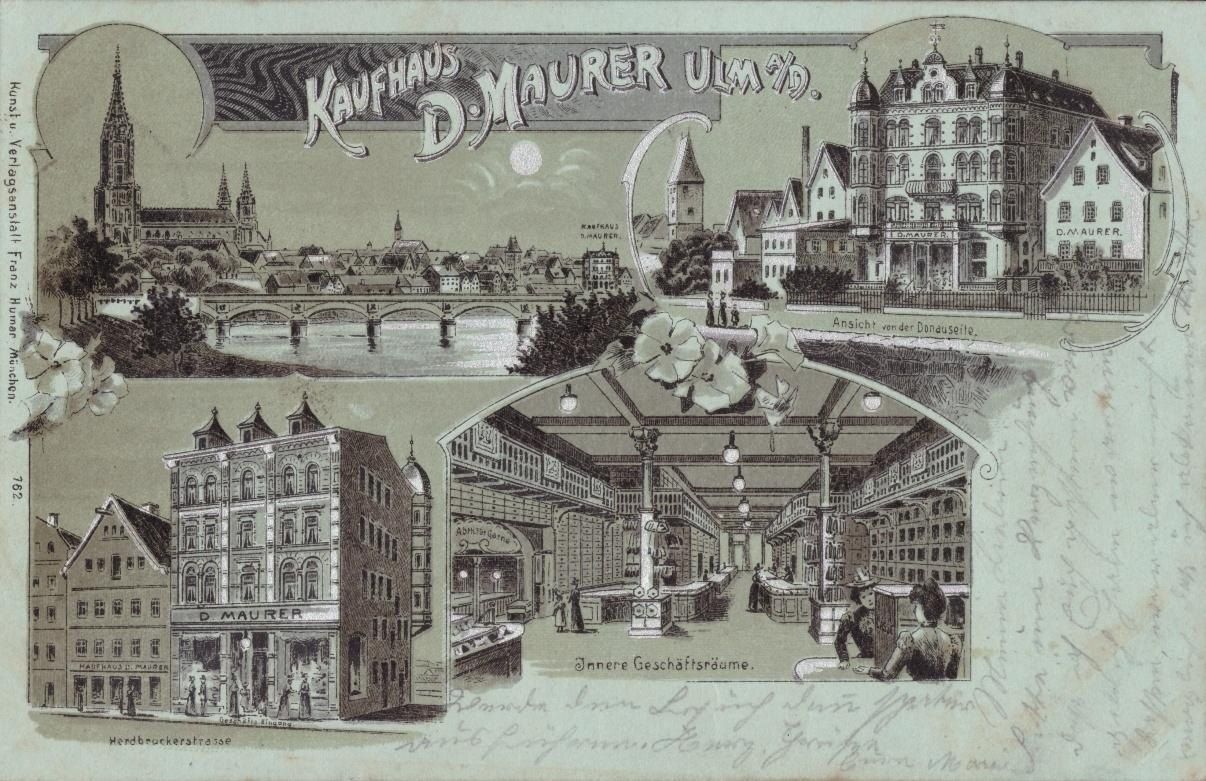
Advertising card of the D. Maurer department store, Ulm, 1901.
On 29 June 1890 the Minster spire was finished – after more than five centuries. The city celebrated with a great historical pageant, from the knights and guilds of the 14th century through the Reformation and the Thirty Years’ War to Schwörmontag. A leporello was issued for the pageant: 14.34 metres long when unfolded, priced at one mark – a day’s wage at the time. It could hardly be sent by post and was rarely bought.
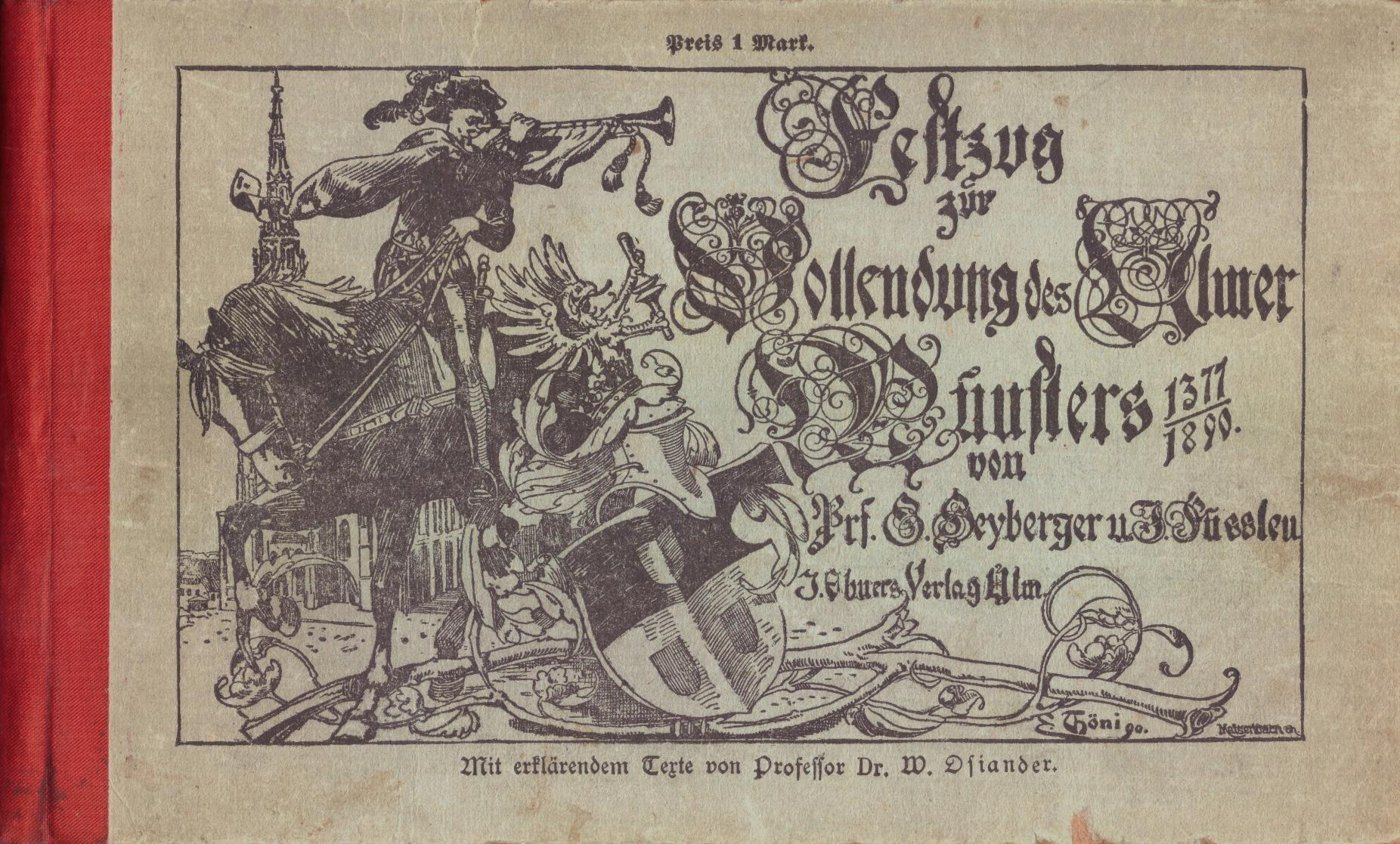
Cover of the leporello for the pageant celebrating the completion of Ulm Minster, 1890.
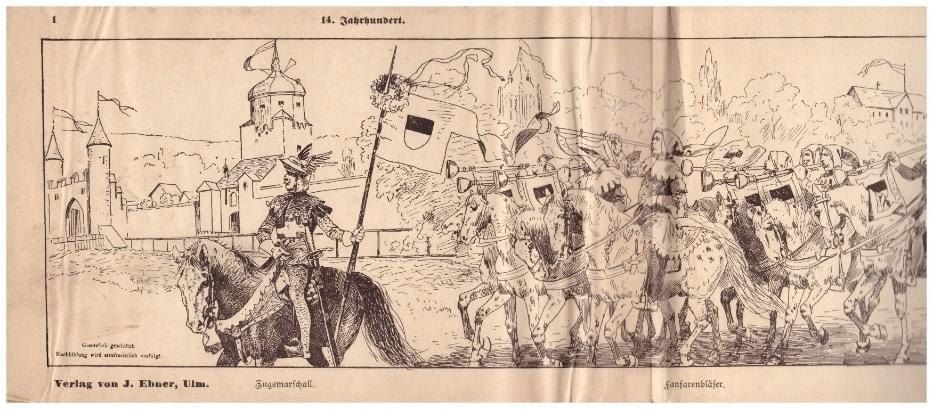
Detail from the leporello.

A section of the pageant in the leporello – unfolded, the whole strip measures over 14 metres.
A city far from the sea – and yet connected to the world. Cards from the Caribbean, the Dutch East Indies and the Levant reached Ulm; sooner or later trade flowed through the city. As late as 1916 a parcel card went from Stuttgart via Ulm and the Danube–Bulgaria route to Constantinople – an old trade route revived in the middle of the war.
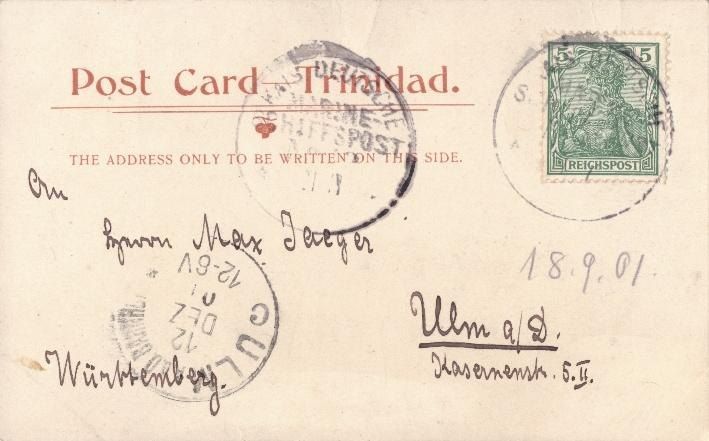
Postcard from Port of Spain, Trinidad, to Ulm, 1901.
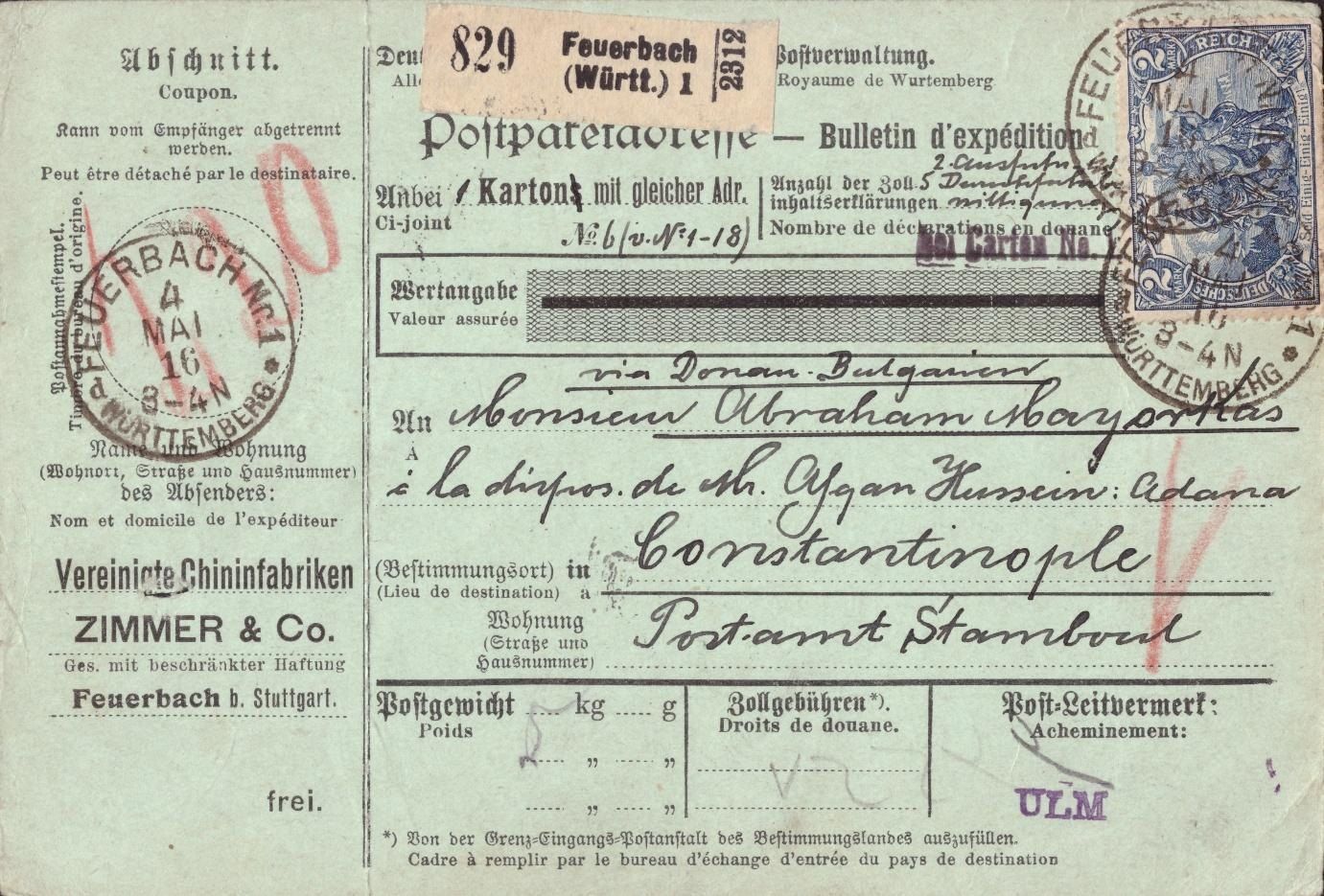
Parcel card from Stuttgart via Ulm to Constantinople, 1916.
At the Congress of Vienna, Austria insisted on a large fortress at Ulm to protect Vienna; the German Confederation paid for it. From 1844 to 1859 the largest fortification of its time was built. At peak times 10,000 people worked on it – an enormous boost for the city. The fortress never saw battle. In the 1890s Ulm bought land and buildings no longer needed at low prices, gaining space for housing and industry.
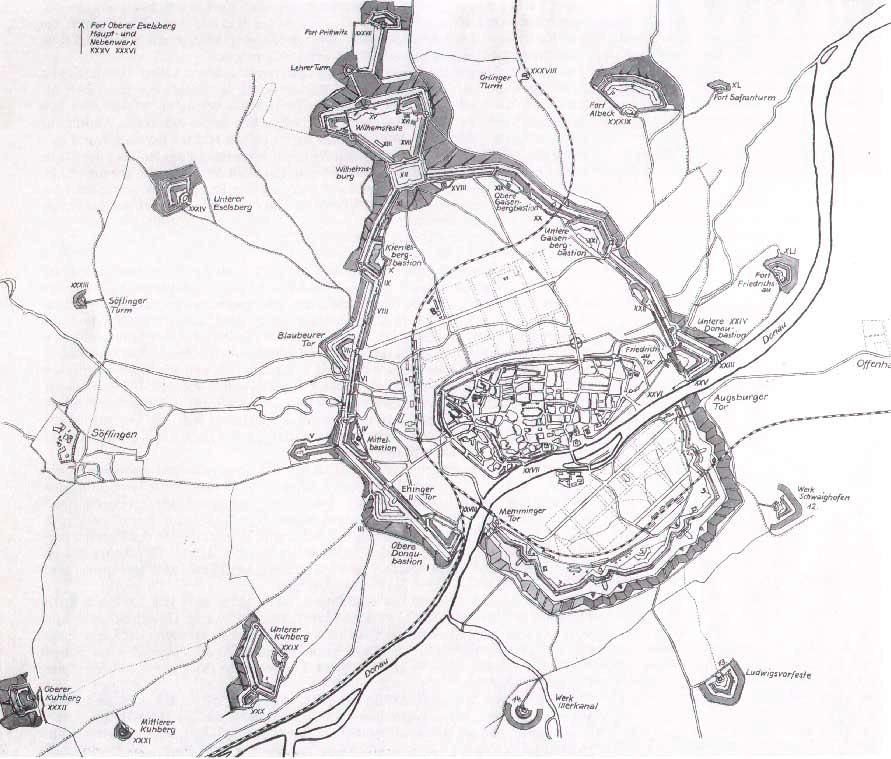
Plan of the Federal Fortress, 1859: Ulm in stone, Neu-Ulm in brick.
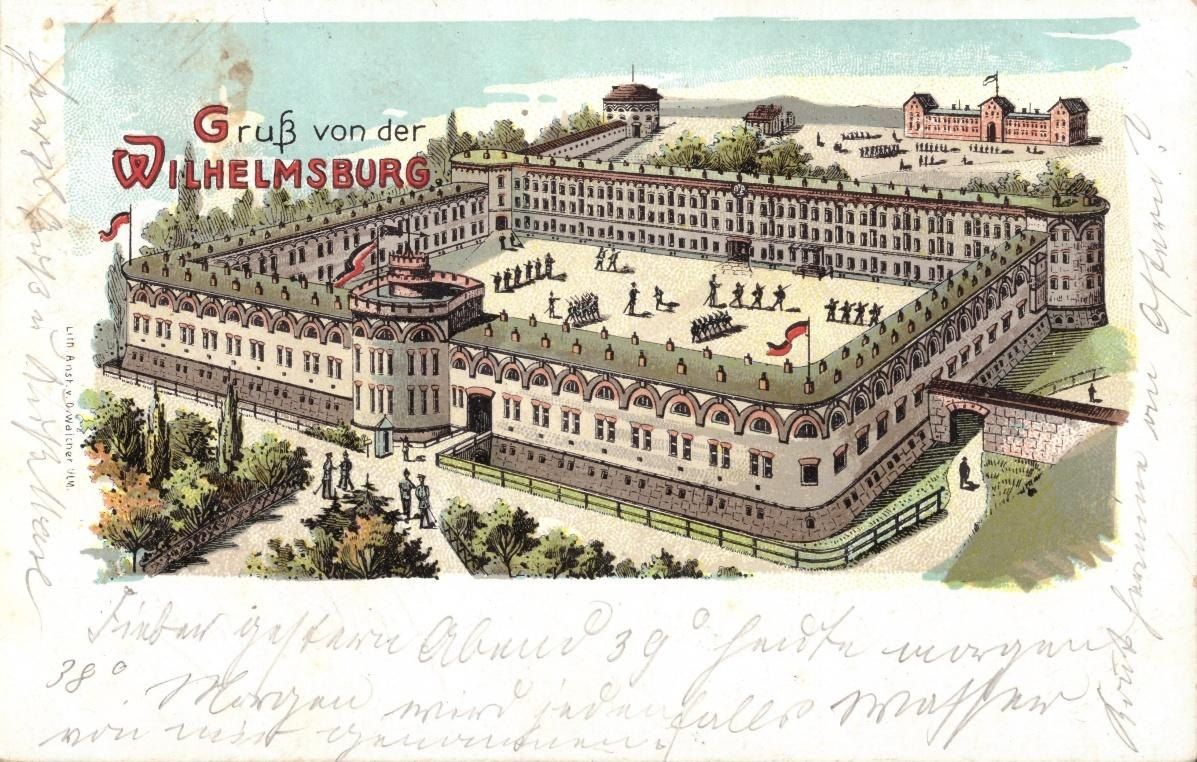
Greetings from the Wilhelmsburg, 1906 – the citadel above the city.
Count Zeppelin began his military career in Ulm and remained attached to the city; he built a villa here and was made an honorary citizen. On 31 July 1909 a Zeppelin flew over Ulm – captured on a rare photographic card. In 1911 cards recalled Albrecht Ludwig Berblinger, the “Tailor of Ulm”, whose attempt to fly had failed in 1811. A hundred years later, airships and aeroplanes were a reality.
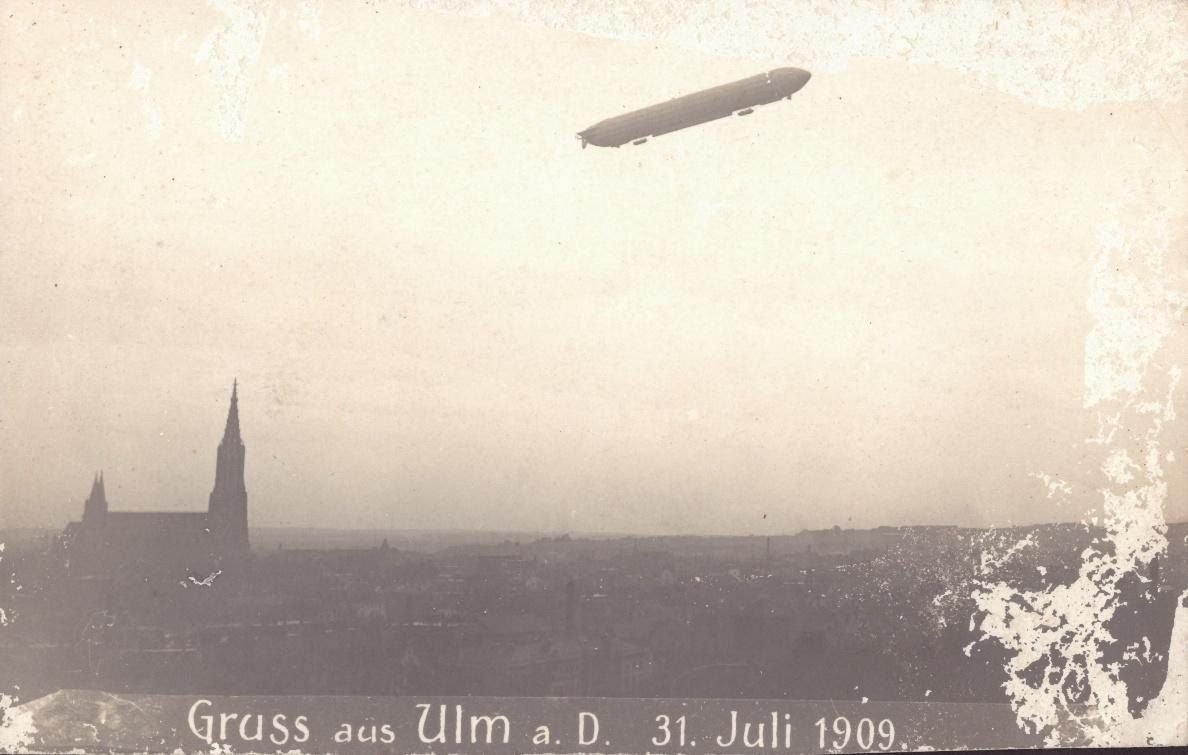
Zeppelin over Ulm, photographic card of 31 July 1909.
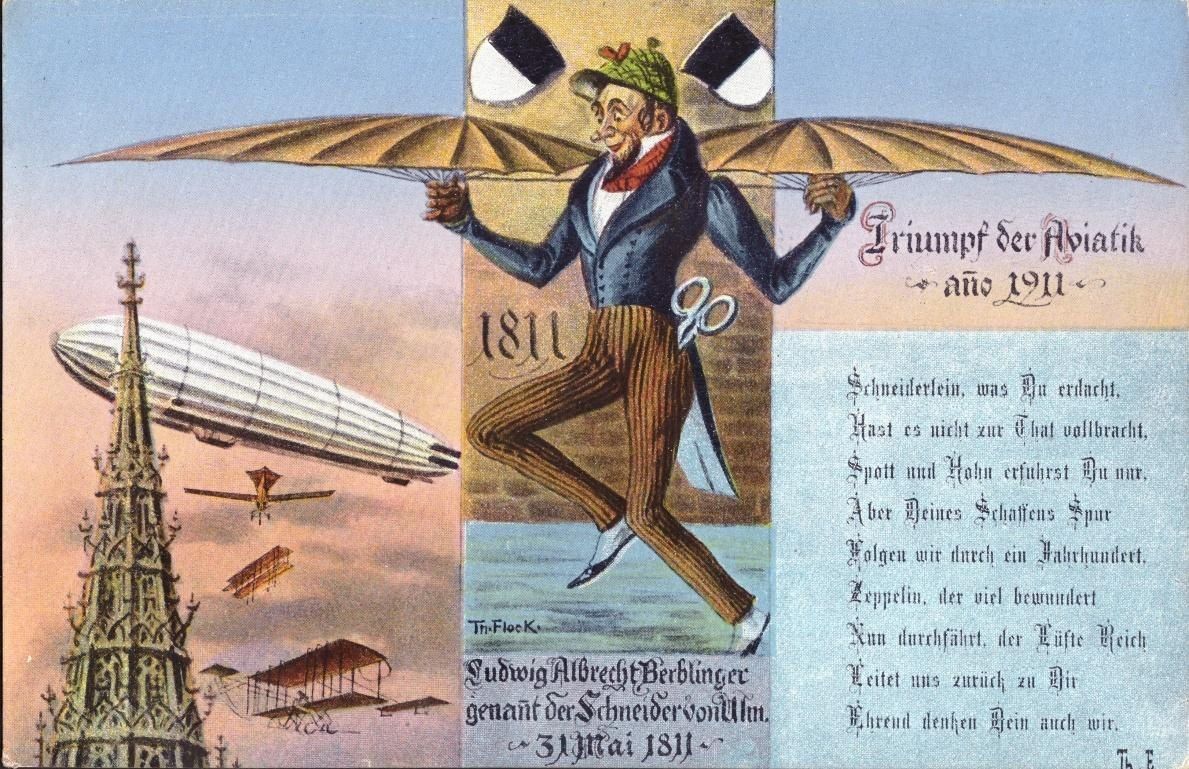
Card of 1911: Berblinger, the Tailor of Ulm, and the triumph of aviation.
Field post is part of Ulm too: in 1900 soldiers from Ulm went to China during the Boxer Rebellion; their letters home travelled with the field post of the East Asian Expeditionary Corps or via Siberia.
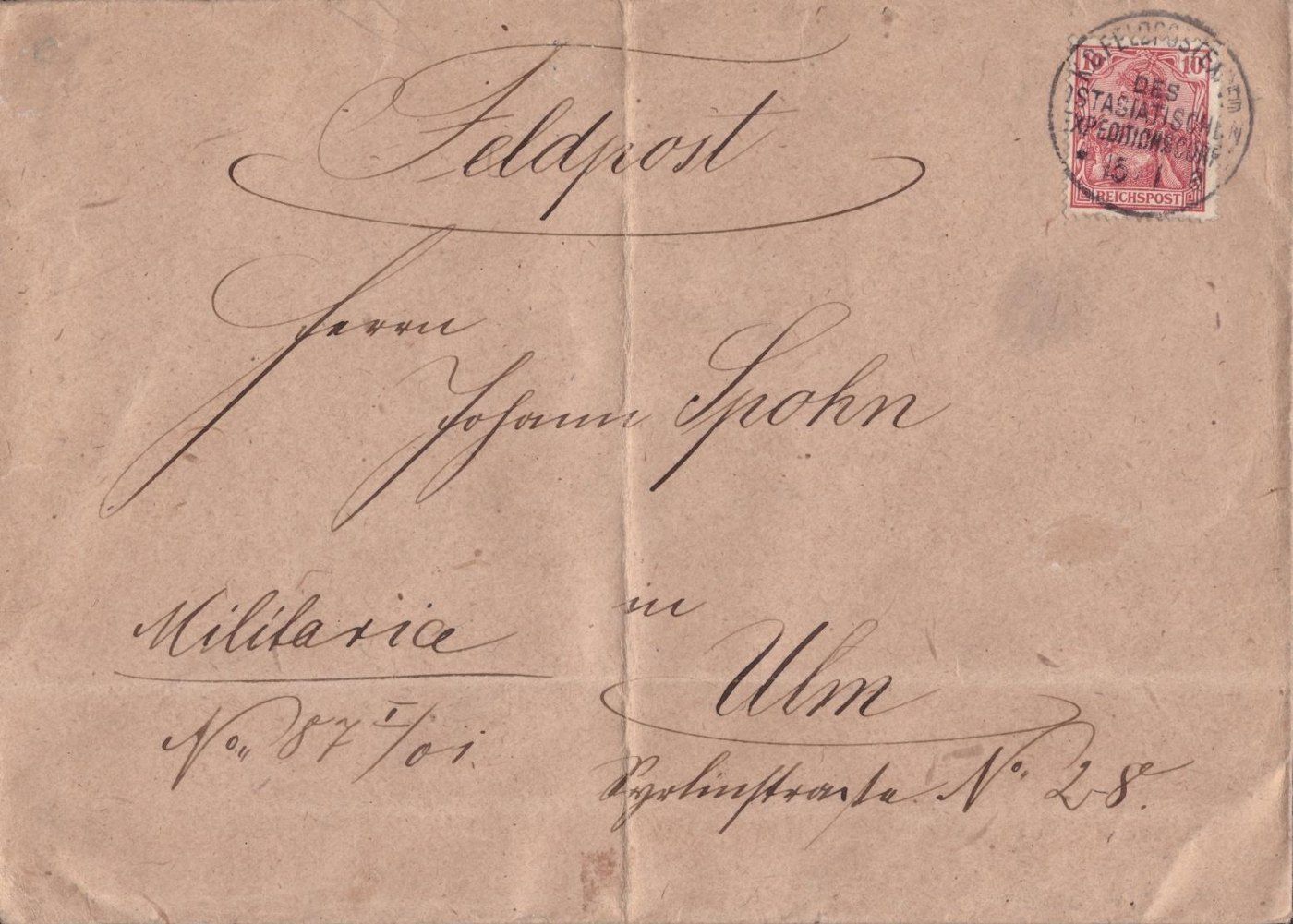
Field post letter of the East Asian Expeditionary Corps to Ulm, 15 January 1901.
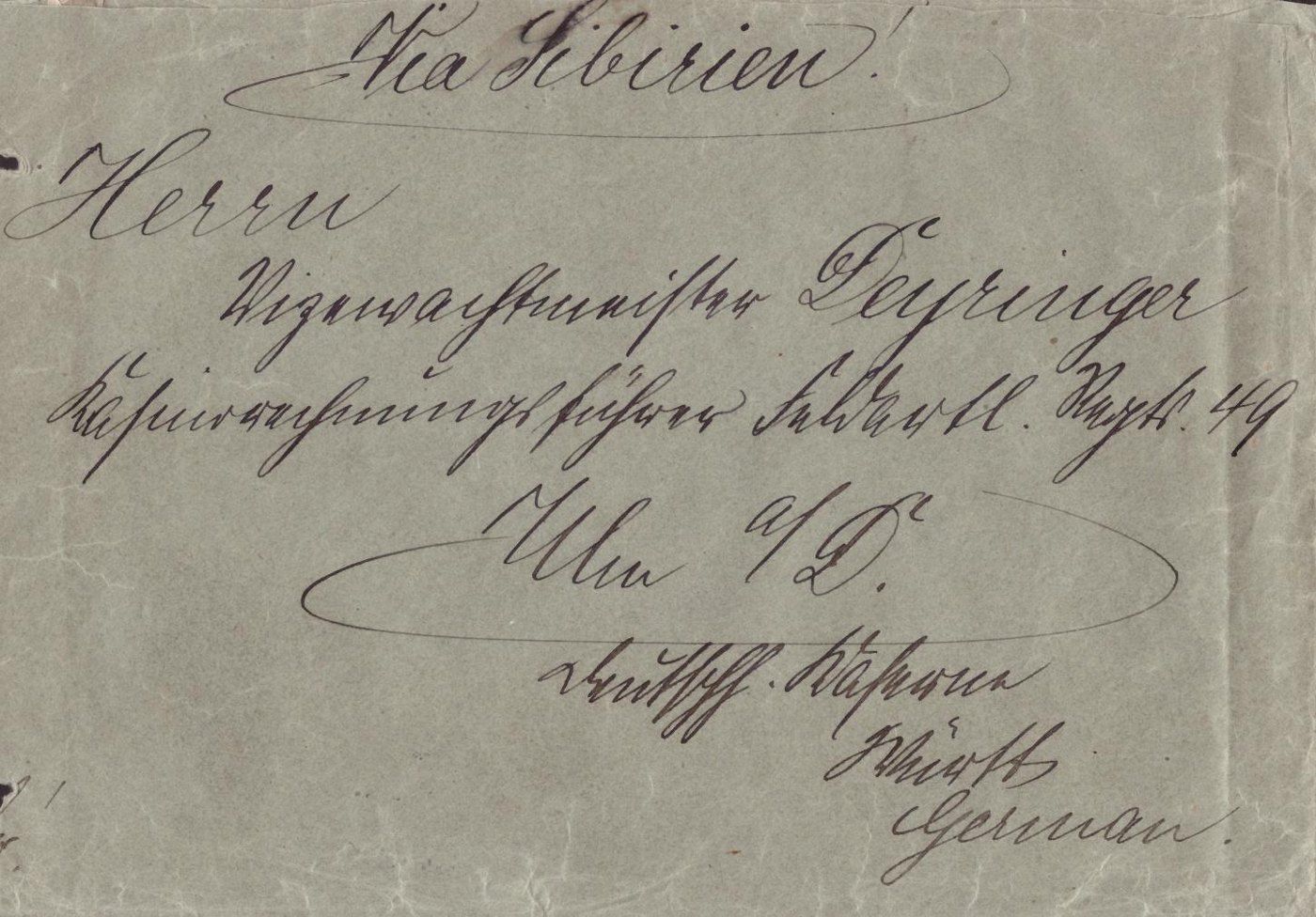
Letter from Tientsin via Siberia to Ulm.
For centuries the Danube was Ulm’s lifeline. In the 1850s three to four “Ulmer Schachteln” (river boats) still left each week; the last one departed on 27 April 1897. The railway had replaced the Danube as a trade route. Mail was handled directly at the station and often delivered the same day; the station square with its hotels and beer garden became the new gateway to the city. Albert Einstein’s birthplace also stood in Bahnhofstraße.
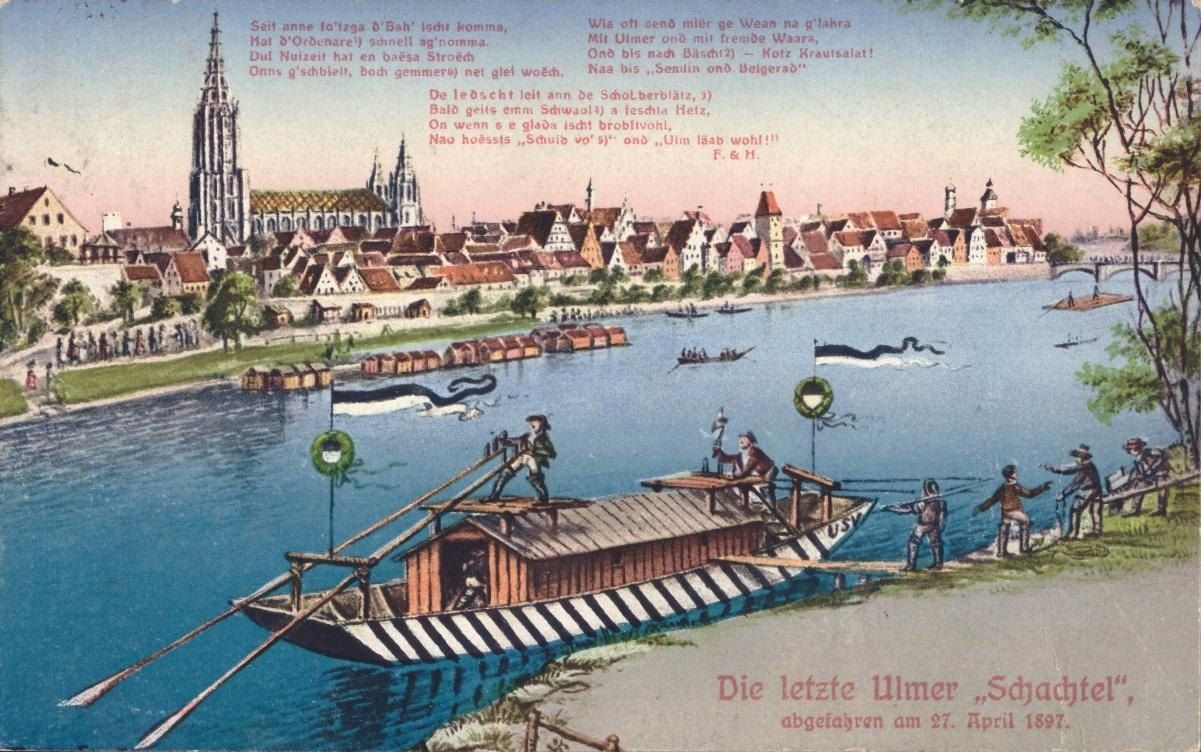
Souvenir card of the last voyage of an Ulmer Schachtel, 27 April 1897.
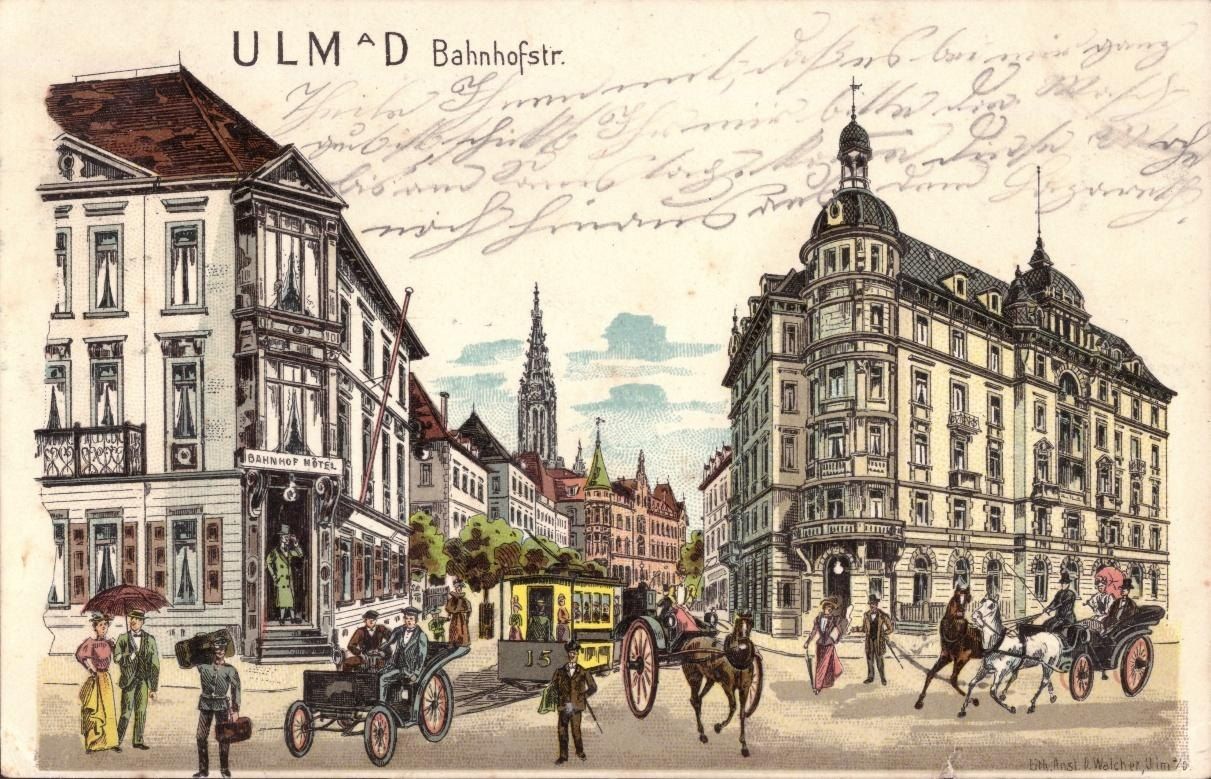
Bahnhofstraße seen from the station square, 1902; on the left Einstein’s birthplace.
Festivals and hospitality made Ulm a magnet: in 1854 even Duke Max in Bavaria, father-in-law of the Austrian Emperor, could only find a room at the small “Lämmle” inn. The same year a special train of 37 fully occupied carriages left Ulm for the Munich Oktoberfest. The illuminated serenade on the Danube is still part of Schwörmontag today.
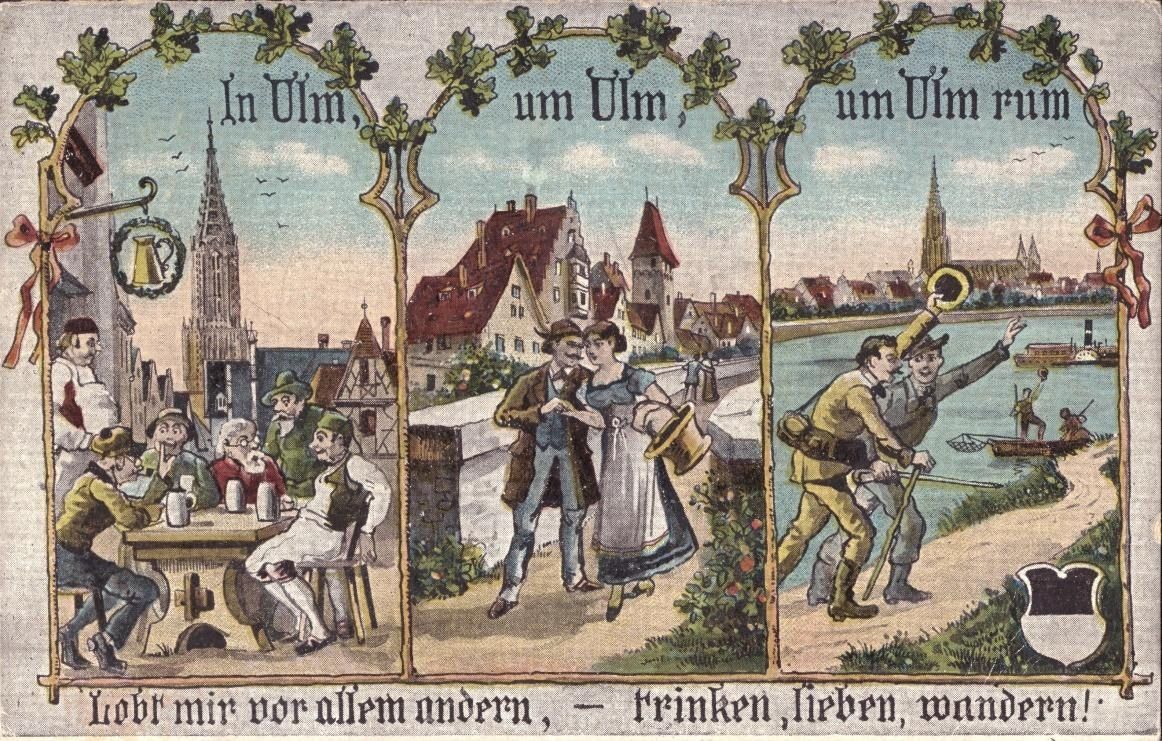
“In Ulm, um Ulm und um Ulm herum” – drinking, loving, wandering.
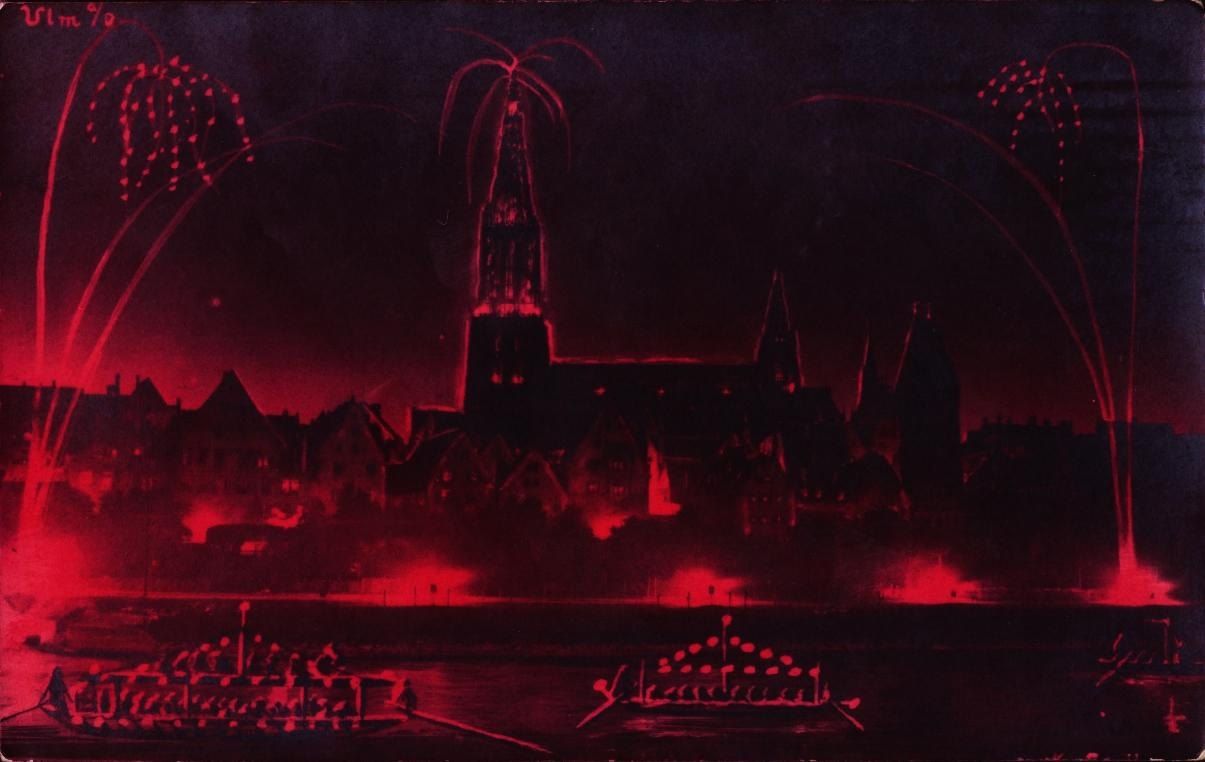
Illuminated serenade on the Danube, around 1913.
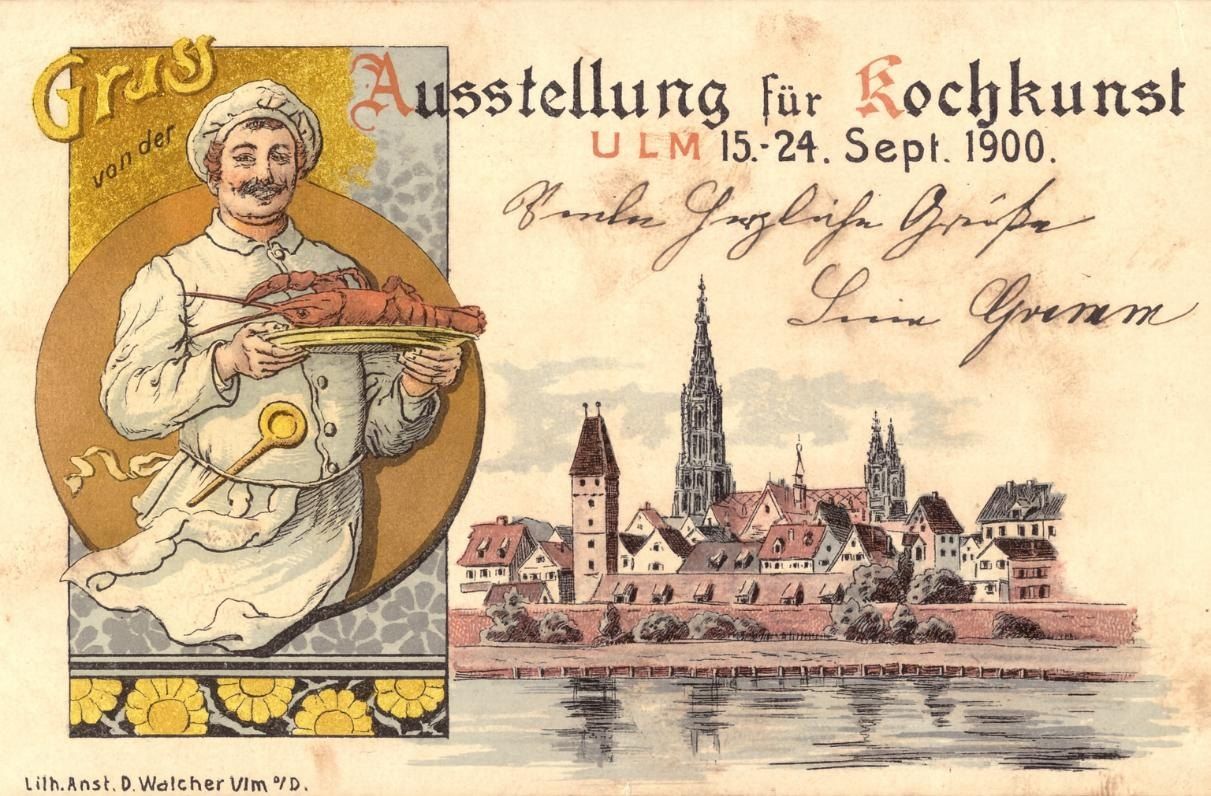
Culinary exhibition, Ulm, 13–24 September 1900.
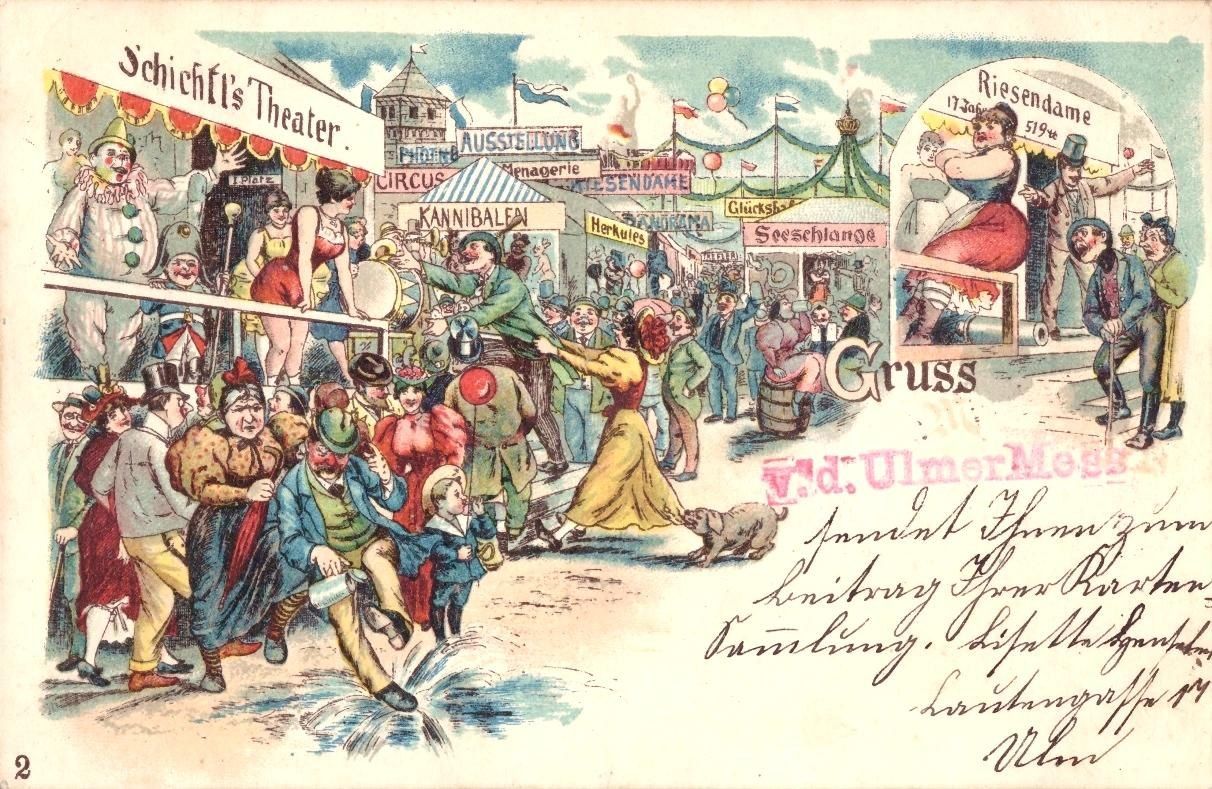
Ulm fair with circus and sideshows, 1898.
The years up to 1914 were a time of growth for Ulm: the impoverished former Imperial City had become a fortress, industrial and transport city. The First World War brought this long flourishing to an abrupt end – the Wilhelmsburg was still in use as barracks in 1917.
How Ulm finally lost its imperial freedom in 1805 is told in part one: Ulm 1805 – the letter of one of Napoleon’s scouts →
Source and author. Text, letters and cards from the collection of Paris Dimitriadis, based on his exhibit „Ulm Revitalised – Strategic Transformation of a City, 1810–1914“. Further reading: „Die Ulmer Bilder-Chronik“ (Karl Höhn Verlag).
More picture postcards and covers from Ulm: Ulm and Neu-Ulm on old picture postcards →
How the tram ran through old Ulm and across to Neu-Ulm is shown in our guide The tramway of Ulm and Neu-Ulm on old picture postcards →
Old letters or postcards from Ulm to sell?
We buy letters, picture postcards and entire local collections – the first assessment is free and without obligation.
Sell letters & picture postcards → · Ulm picture postcards in our shop →
sammlershop-tk@gmx.net