GUIDE · POSTAL HISTORY OF ULM
On 21 October 1805, one day after the Austrian army surrendered, a French officer outside Ulm wrote a letter to Nantes. For more than 200 years nobody knew who he was.
By Paris Dimitriadis
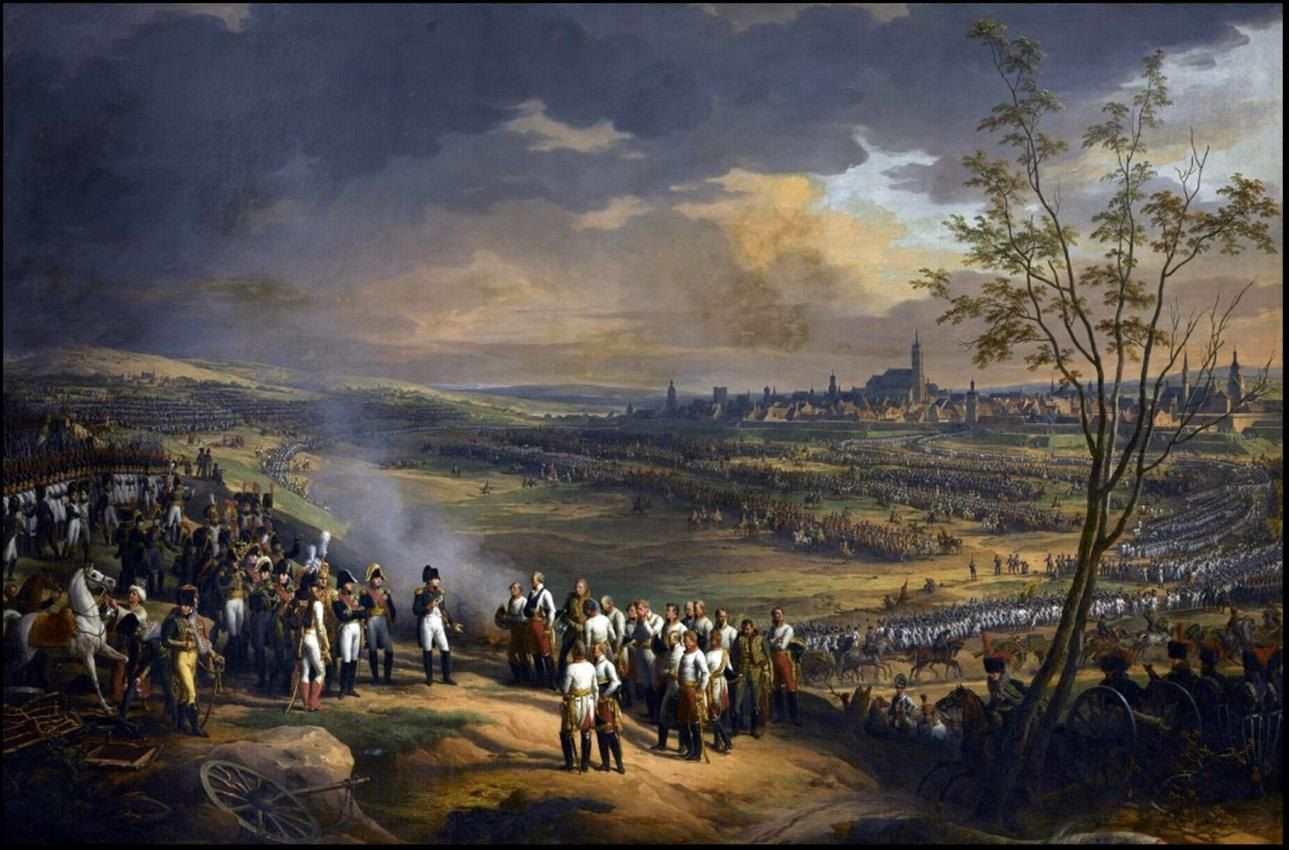
Napoleon receives General Mack’s surrender on the Michelsberg, 20 October 1805. Painting by Charles Thévenin.
The postal history of Ulm has many rare items. Few, however, speak as directly of a turning point in European history as this letter. It is signed “V.B.”, passed through a French field post office with a handstamp used for only a few months – and its writer had shortly before reconnoitred the fortifications of Ulm under cannon fire.
For centuries Ulm was a Free Imperial City. Around 1500 it was at its height: salt, iron, wine, grain and above all the Ulm fustian cloth prized all over Europe passed through its markets, and trade between the Netherlands and northern Italy ran through the city. “Ulm money rules the world”, people said. Wars, occupations and epidemics weakened the city in the 17th and 18th centuries; by 1770 it was bankrupt and had to sell property, including the lordship of Wain.
With mediatisation in 1802 Ulm passed to Bavaria, confirmed in 1803 by the Reichsdeputationshauptschluss. The change can be seen on letters: early town handstamps such as “D’ULM” date from the Imperial City period, while Bavarian times brought rayon handstamps such as “R3 ULM”.
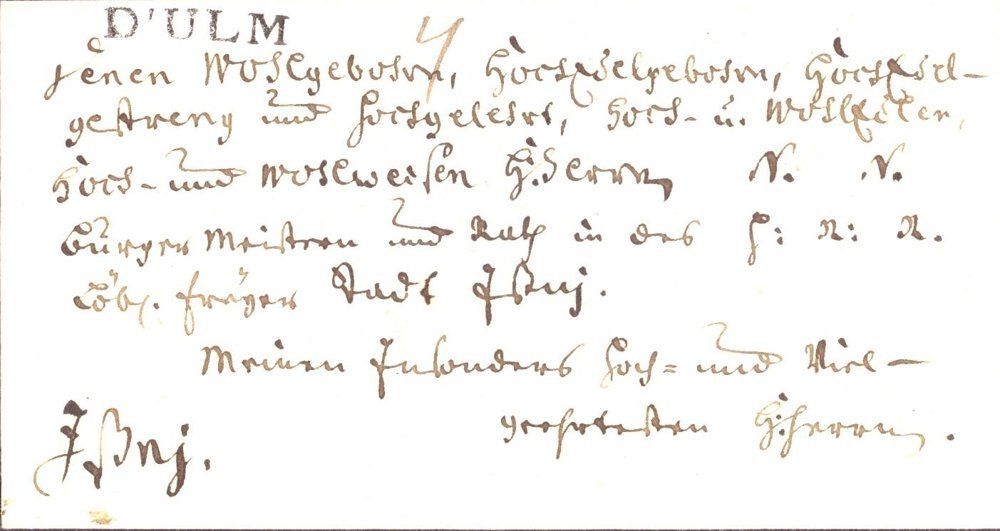
Letter of 1785 from Ulm to the mayor of Isny in the Allgäu with the one-line handstamp “D’ULM”.
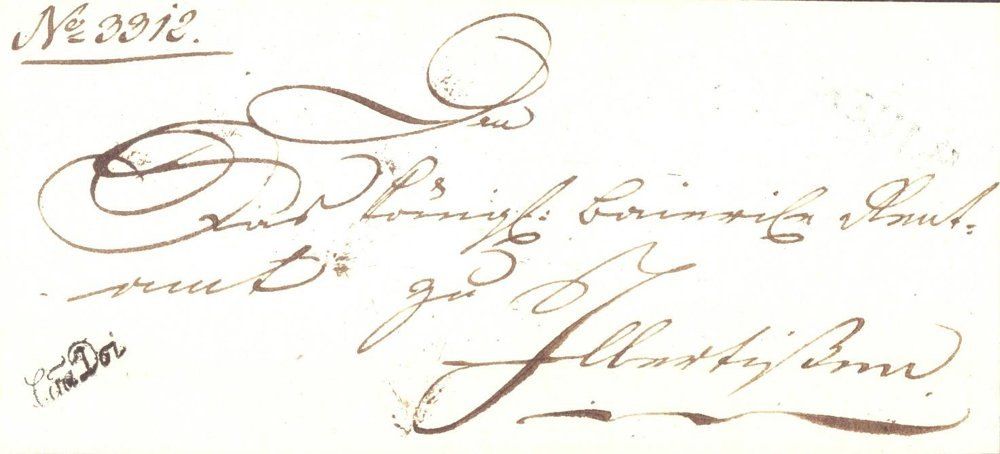
Official letter, free of postage, from the Bavarian period, Ulm to Illertissen, with rayon handstamp “R3 ULM”. “Caa Doi” stands for Causa Domini – mail sent in the name of the sovereign.
In 1805 Napoleon gave up his plan to land in England and turned against Austria and Russia – the start of the War of the Third Coalition. His troops, including the Army of Holland assembled for England, marched to the Danube within a few weeks. Chief of staff Louis-Alexandre Berthier had already organised the supply of the regiments in detail that spring.
In October 1805 the Austrians under General Mack, beaten at Elchingen, fell back on Ulm. The medieval walls could not withstand the encirclement. On 20 October the garrison laid down its arms before Napoleon on the Michelsberg.
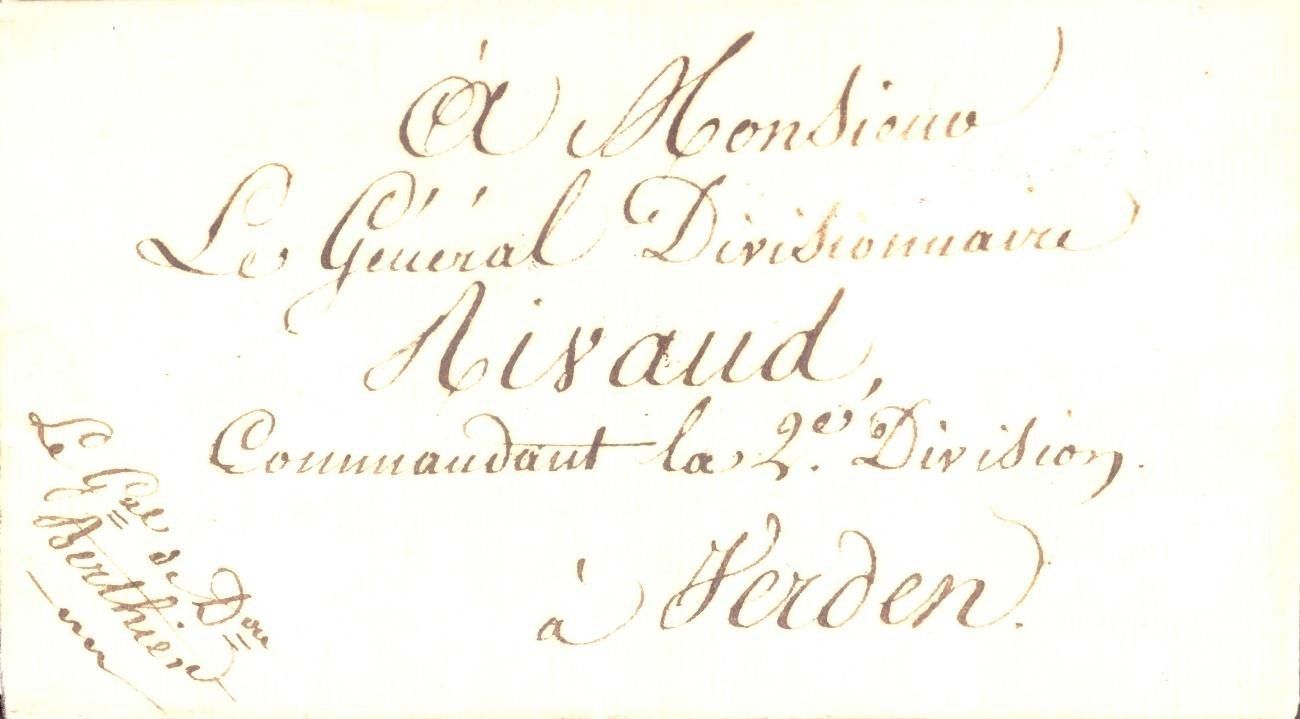
Autograph letter from Marshal Berthier in Hanover to General Rivaud in Verden, 4 May 1805 – instructions on rations and pay for the troops.
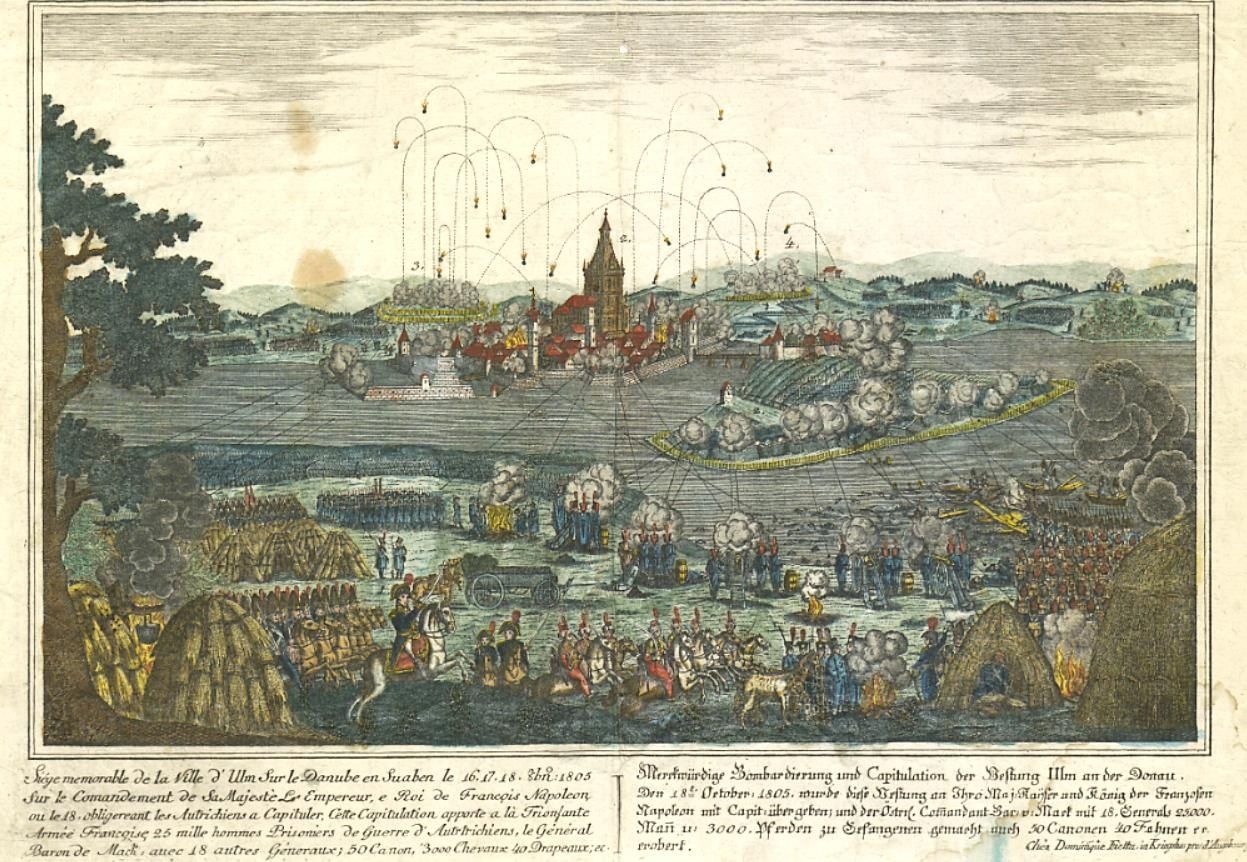
Contemporary depiction of the siege and surrender of Ulm in October 1805.
The letter is dated “Ulm, 29 Vendémiaire” – 21 October 1805 in the French Revolutionary calendar. It first passed through French Field Post Office No. 4 with the handstamp “ARM. DE HOLLANDE” and was then handed over to the civil post for Nantes. This handstamp of the Army of Holland was used only from September to December 1805. The charge of 9 décimes corresponds to a letter under 6 grams over 600 to 800 kilometres from the French border.
What is missing is remarkable: a senior officer would have signed with his full name and rank, and his letter would have travelled free of charge. This letter bears only the initials “V.B.” – and postage had to be paid.
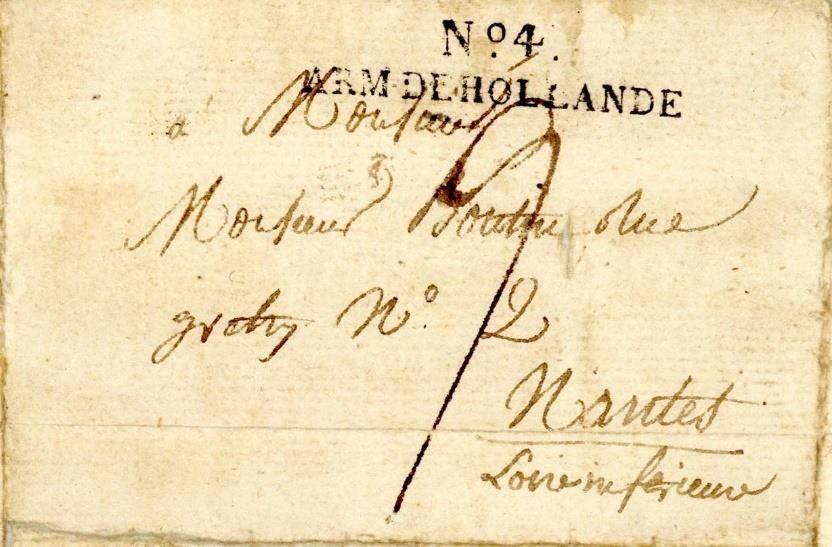
Front of the letter from Ulm to Nantes with the field post handstamp “No. 4 / ARM. DE HOLLANDE”.
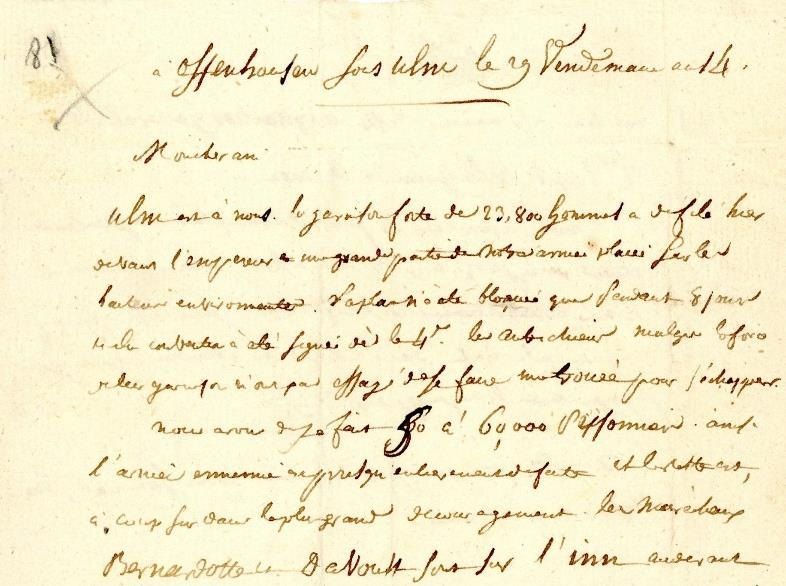
The first page of the letter: “Ulm est à nous” – Ulm is ours.
The letter in English translation
Offenhausen near Ulm, 29 Vendémiaire, Year 14 (21 October 1805)
My dear friend,
Ulm is ours. The garrison, 23,800 strong, marched past the Emperor and a large part of our army yesterday, which was drawn up on the surrounding heights. The town was blockaded for only eight days, and the convention was signed as early as the fourth day. Despite the strength of their garrison, the Austrians made no attempt to break out and escape.
We have already taken 50,000 to 60,000 prisoners, so the enemy army is almost entirely defeated, and the rest is surely utterly disheartened. Marshals Bernadotte, Davout and Soult are advancing to the Inn to meet the Russians, of whom they are said to have taken prisoners already. Tomorrow we return to Augsburg to join the two other corps.
I reconnoitred the gates of Ulm and the outworks of the fortress. Several cannon shots were fired at me and narrowly missed. I am surprised no one fired at me with muskets – I was only half a range from the main rampart.
Farewell. Greetings and embraces to all our relatives and friends. I embrace you.
Postscript: My dear Boutin, I am still at the headquarters of the 2nd Corps of the Grande Armée. We had four days of dreadful rain and were soaked to the bone. My things were in poor shape and our boots were worn right through. I had a pair made in a hurry in Ulm until I get back to my baggage. In all we have lost fewer than 4,000 men – killed, wounded and prisoners together.
Original in French; first transcribed and translated by Paris Dimitriadis.
When the letter appeared at auction, its date had been misread and its text had never been transcribed. The first assumption was obvious: a marshal or general so well known that his initials were enough. A comparison with the handwriting of every marshal and general of the campaign who came into question, however, produced no match.
The clue lay in the letter itself: a careful transcription revealed the name “Boutin” together with a reference to the family. A handwriting comparison with a document in the French National Archives provided certainty – the writer is Vincent-Yves Boutin (1772–1815). By using only his initials he sought to remain unrecognised on his dangerous mission.
Boutin came from Nantes and served as an engineer officer. In 1800, under Lecourbe, he threw a bridge across the Rhine near Reichlingen under enemy fire; he then surveyed the routes over the Gotthard and the Simplon and prepared the blockade of the castle when the French entered Milan. In August 1805 he came to the upper Danube under Napoleon’s direct command.
Outside Ulm he reconnoitred the Danube bridges, the town gates and the outworks – only two to three hundred toises, about 390 to 585 metres, from the Austrian positions. His conclusion: the old fortifications were no longer a match for modern warfare. In 1808 a mission took him to Algiers; decades later his notes served as the basis for the French campaign of 1830.
While Boutin was writing his letter, the Franco-Spanish fleet lost the naval battle against Britain at Trafalgar. Ulm showed Napoleon’s strength on land, Trafalgar his weakness at sea. In November the French occupied Vienna, and on 2 December Napoleon won at Austerlitz.
| 1802/1803 | Ulm loses its imperial freedom and passes to Bavaria; the Reichsdeputationshauptschluss of 25 February 1803 confirms the reorganisation. |
| 18 May 1803 | The Peace of Amiens collapses; France and Britain are at war again. |
| 1803–1805 | Napoleon gathers troops on the Channel coast and in Holland for a landing in England. |
| September 1805 | The army is redirected to the Danube – against Austria and Russia. |
| 20 October 1805 | The Austrian army under General Mack surrenders at Ulm. |
| 21 October 1805 | Boutin writes his letter “Ulm est à nous”. The same day the Franco-Spanish fleet loses the Battle of Trafalgar. |
| 2 December 1805 | Napoleon defeats the Austrians and Russians at Austerlitz. |
| 1810 | Exchange of territory between Bavaria and Württemberg: Ulm becomes part of Württemberg. |
After the Peace of Pressburg at the end of 1805, Bavaria and Württemberg became kingdoms. Ulm remained Bavarian for the time being and a French base. A letter from the French headquarters at Ulm of 7 May 1806 to the Bavarian governor of the province of Swabia, Count von Leyden, complains about supplies for the military hospital – written on a form actually intended for Innsbruck and the Tyrol. In 1810 Ulm passed to Württemberg in an exchange of territory; the opposite bank remained Bavarian, and Neu-Ulm grew up there.
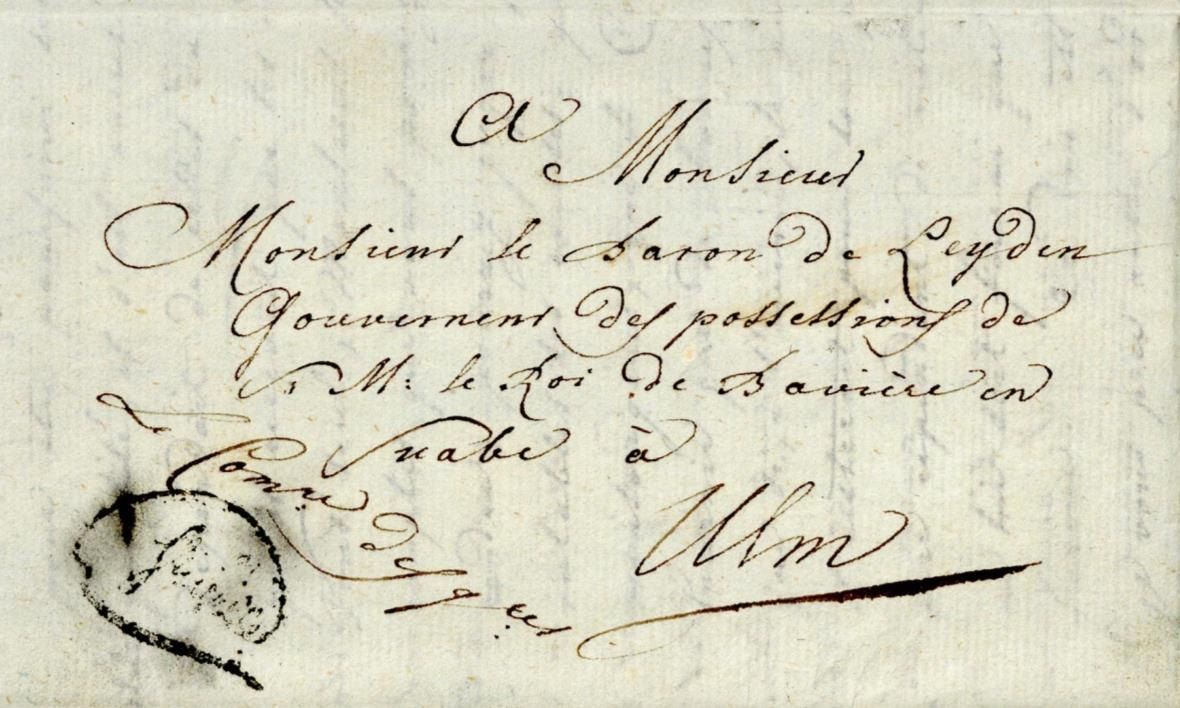
Letter from the headquarters of the French occupation at Ulm to Count von Leyden, governor of the Bavarian province of Swabia, 7 May 1806.
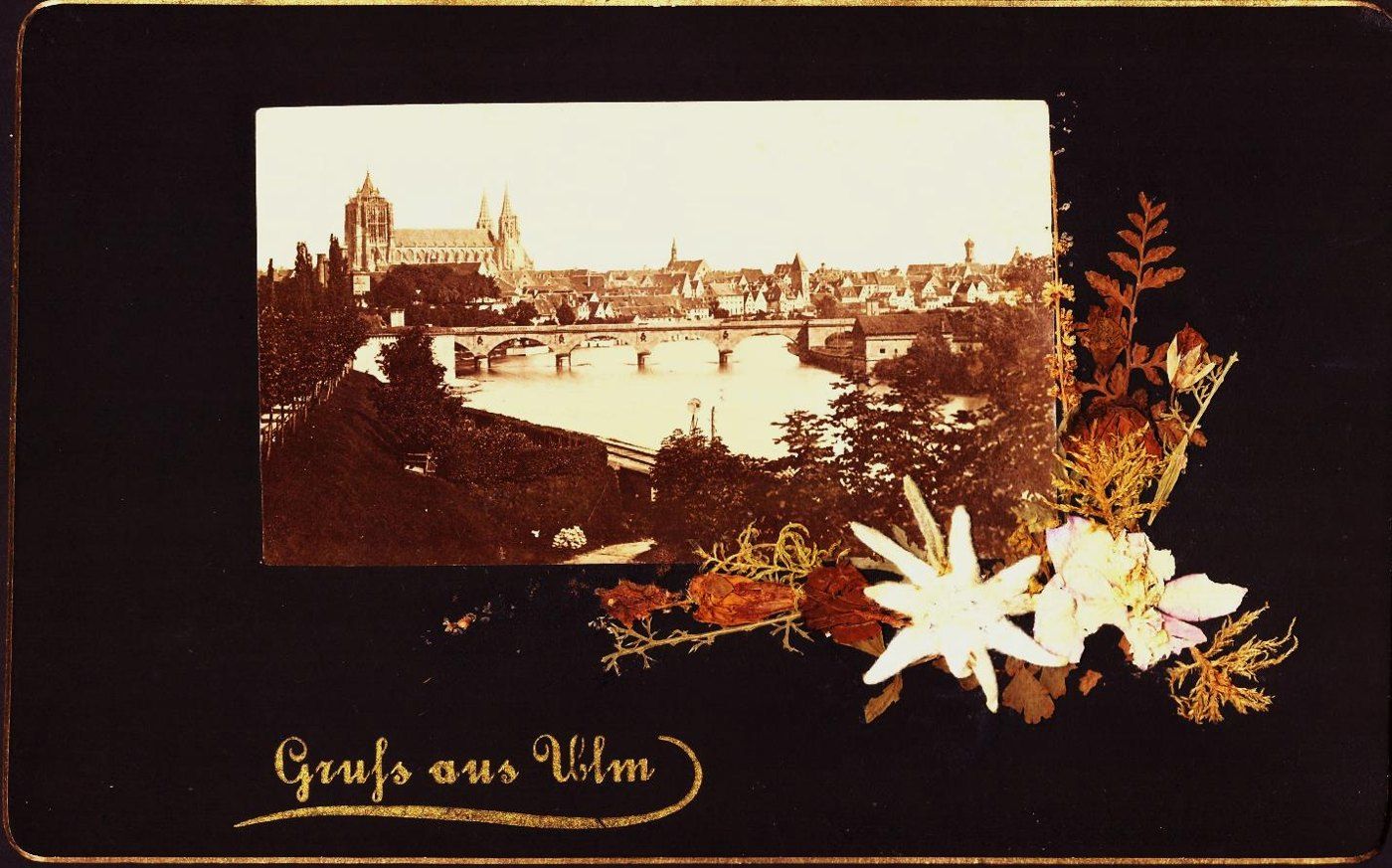
Early card with a mounted photograph and dried plants: the Minster still with its temporary roof – as it also looked in 1805.
How Ulm then became a fortress and industrial city is shown in part two: Ulm 1810–1914 on letters and postcards →
Source and author. Text, letters and illustrations from the collection of Paris Dimitriadis. In full, with bibliography: Paris Dimitriadis, „Napoleon’s Spy: Vincent-Yves Boutin and the Strategic Role of Intelligence in the 1805 Ulm Campaign“, The London Philatelist, May 2025, pp. 192–198.
Further reading: Dürr, Ludwig, Vogel, „Die Ulmer Postgeschichte“; A. Reinhardt, „Französische Armeepost 1792–1848“.
More picture postcards and covers from Ulm: Ulm and Neu-Ulm on old picture postcards →
Old letters or postcards from Ulm to sell?
We buy letters, picture postcards and entire local collections – the first assessment is free and without obligation.
Sell letters & picture postcards → · Ulm picture postcards in our shop →
sammlershop-tk@gmx.net